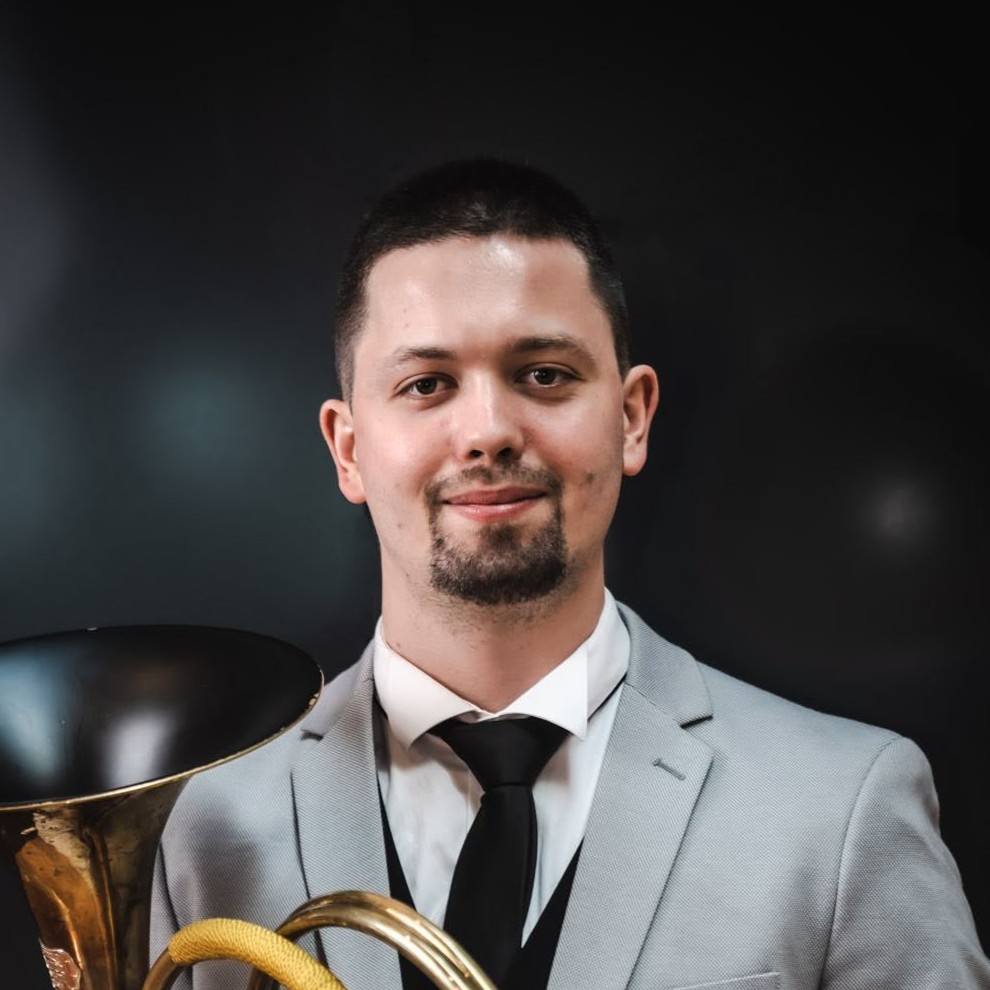
Márton Kóródi, tell us about your musical upbringing and education: did you grow up in a musical family? When did you start studying music?
I wasn’t born into a musical family—my parents are veterinarians and equine-assisted therapists—but they always emphasized the importance of learning an instrument for me and my siblings. When I started elementary school, I applied to the local music school in Kaposvár and was accepted, but I didn’t start right away. Instead, playing football with my friends took priority. However, a few years later, when I was 10, I decided to give it another try. I began learning the tenor horn, and things progressed fairly well. I still remember the immense sense of accomplishment I felt when I joined the music school’s wind band after just one year of playing.
In my second year of studying music, something shifted within me, and I became motivated to pursue music more seriously. I can’t quite recall the exact reason, but part of it was my desire to explore the world, meet new people, and experience different cultures. When I shared this motivation with my current teacher, he suggested I switch instruments, recommending either the trombone or the horn, as the tenor horn was rarely used in classical music. Given that he was a hornist, József Kocsis, I suspect he gently nudged me in that direction. Though I’m not sure if he “pushed” me, I’m grateful he did.
I later attended the Leó Weiner Music Secondary School in Budapest, where I studied under Tamás Gáspár and Zoltán Varga. This is where I began to shape my professional career and seriously prepare for it. In 2017, I was accepted into Szabolcs Zempléni’s class, first in Trossingen and later in Hamburg. I’ve always been fascinated by the instrument, so it was a real highlight when Szabolcs organized a natural horn course every year with different teachers. One of these masterclasses, with Teunis van der Zwart, was the moment I first began to seriously consider pursuing my master’s in historically informed performance. This led me to seize every opportunity to perform on the natural horn and gain experience, and eventually, I began thinking about furthering my studies in The Hague. It was a fortunate moment when I realized that the university where my wife was studying, where Teunis was teaching, and where I met Mees Vos—a teacher I believed could help me develop further—was the perfect fit for my goals.
When and why did you decide to focus on period instruments?
What drew me to historical performance? Initially, I was curious about the natural horn—how it works, how its technique could improve my playing on the modern horn, and I’ve always been captivated by its colorful sound. Over time, I became more interested in historical performance as a whole, and this curiosity evolved into a deeper exploration of why it was valuable and what insights we could gain from it in modern performance practice. This is what led me to focus more on the periodic instrument and ultimately to audition for the Theresia Orchestra.
What do you think was the most memorable experience that made you decide to become a professional musician? Are there any musicians you have met who you consider to be your mentor(s)?
I don’t recall a single moment when I decided to become a professional musician, but there are a few key projects and encounters that reassured me of my potential and inspired me to follow a path that, to this day, I continue on.
In 2015, I won the audition for the Verbier Festival Youth Orchestra for the first time, which felt like a huge achievement and source of inspiration. Before I received the confirmation email, I could hardly believe that I would actually become a member of that orchestra. Up until then, I had no real understanding of the professional music world. It wasn’t until I started secondary school that I began to learn about it, and coming from a background of playing in local bands, the experience of joining such a prestigious ensemble opened my eyes to an entirely new side of being a musician. There, I met many talented individuals whose knowledge and preparation far surpassed mine, giving me a completely fresh perspective on the world of music.
Less than a year later, as my school celebrated its 25th anniversary, we had a concert in which we accompanied some of the school’s alumni who had gone on to become renowned artists. One of them was Szabolcs Zempléni. I was struck by how conscious he was while playing, the effortless quality in his sound, and the apparent ease with which he controlled everything. After one of the rehearsals, I mustered all my courage and asked if I could have a lesson with him. A few more followed, and it became clear to me that I wanted to study in his class. The years I spent under his guidance shaped my approach to horn playing in many ways—technique, interpretation, and the way I think about pieces. Everything else I learned from others I built upon the solid foundation he gave me.
I also have to acknowledge the significant impact the teachers at the Royal Conservatoire of The Hague have had on my career. Mees Vos, my modern horn teacher, helped me navigate the vast amount of information I had gathered before working with him, and played a crucial role in helping me find my voice as an artist. Additionally, Teunis van der Zwart introduced me to the world of early music, which has been an essential part of my journey.
When and how did you find out about Theresia and decide to audition? What was the experience of auditioning for Theresia like?
As I mentioned, I’ve been part of the early music community since I began studying in The Hague, so I’ve watched my fellow students get accepted to Theresia. I had considered applying for the audition in 2023, but for some reason, I couldn’t follow through. This year, I made it a goal to apply and see what would happen. I’m glad I did, as I was able to participate in this unique audition process.
What’s special about the Theresia audition is that it doesn’t follow the traditional format; instead, it’s held as a chamber music session. On one hand, this makes the experience much more comfortable and less stressful, as playing with others feels more natural than standing alone on stage under the scrutiny of many judging eyes. On the other hand, this format also provides the jury with more valuable insight. They can assess whether the candidates’ technical skill and musicality meet the required standard, while also observing how well we interact with other musicians and respond to new instructions from the committee. Additionally, it gave us the opportunity to get to know each other better, which is important for building connections with our future colleagues in Theresia.
You took part in the Nova Gorica project: what did you like most about this experience?
The sound of an orchestra with period instruments, and the work ethic within the early music community, are what I truly value. I feel that there is always more room for discussions about the right sound color or articulation in period instrument ensembles than in groups with modern instruments. Since we play period instruments, it’s essential to explore our options and figure out what works best on the instruments in each specific piece. Working with and getting to know Enrico Onofri was also an incredible experience. His knowledge, kindness, and the way he interacts with all of us young musicians elevated the entire project to another level.

Márton Kóródi – on the left – with the others Theresia’s wind players in Nova Gorica
In the next project you will be working with Alfredo Bernardini: have you met him yet? What do you expect from him?
I met him only at the audition in July, so I don’t know him well, but I can share the impressions I gathered from our brief conversation afterward. There is no doubt in my mind that he will be well-prepared for the project and will know how to collaborate effectively with wind players. He also seems like a kind person and a great educator. For me, it’s important to work with people who are not only talented artists but also have good personalities, especially when working with students or those at the beginning of their professional careers. I believe it will be a fantastic experience and an unforgettable memory working with him.
What’s special about the Theresia audition is that it doesn’t follow the traditional format; instead, it’s held as a chamber music session. This makes the experience much more comfortable and less stressful, as playing with others feels more natural than standing alone on stage under the scrutiny of many judging eyes – Márton Kóródi
Do you have any other passions besides music?
Of course, I do. I’ve always admired people who can dedicate all their time to music, but for me, it’s important to step away from it at times and seek other sources of inspiration. I watch a lot of sports and go to the gym 2-3 times a week. I also enjoy hiking with my wife and playing football with friends. Additionally, I like to get creative in the kitchen, and recently, I’ve started learning about investments.
Where do you see yourself in five years time? A musician in an orchestra, a musician with your own ensemble, a teacher… tell us about your plans.
Actually, it’s a healthy combination of the options you mentioned. My goal is to be an orchestral musician, with the opportunity to teach, ideally in a secondary music school. It’s also our responsibility to introduce music to children, so they can become the audience of the future. Lastly, I’m working hard to take the Hungarian Brass ensemble to the next level in its career. We founded the ensemble four years ago, and next February, we’ll finally be recording our first album. Hopefully, this will help us gain more recognition, and we’ll be able to entertain people with high-quality brass music wherever we go.

