The new string project: Cambini, Kraus and Boccherini

By Emilia Campagna - January 16, 2019
The first Academy of 2019 is a string project with tutors Chiara Banchini and Roel Dieltiens. Let's find more!

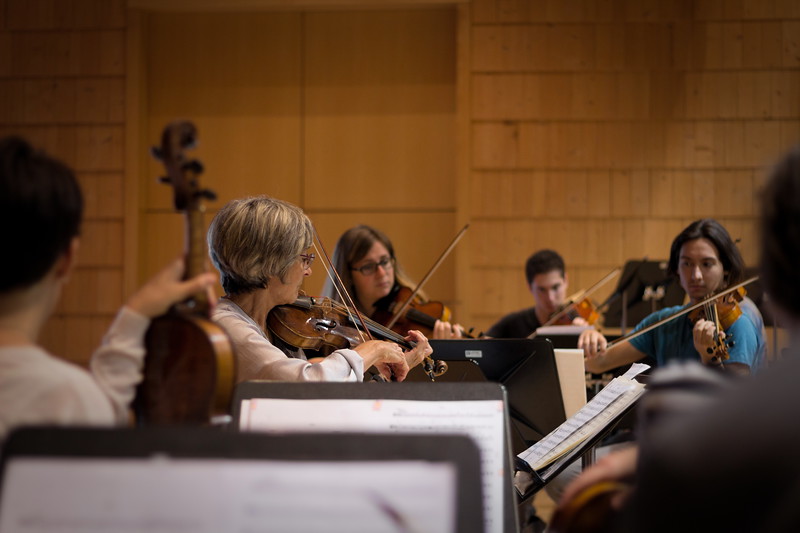
What’s better than an entire week of chamber music, working on classical Quartets and Quintets together with two renowned musicians? The new string project, i.e. the first Academy of 2019, is being an amazing experience: it started on Monday 14th and will go on till Friday, with tutors violinist Chiara Banchini and cellist Roel Dieltiens.

Our home for this week of study and music is the venue of Fondazione iCons in Lodi, the perfect place for focusing and working in small ensembles.

The musicians involved in this new project are sixteen, coming from six different countries: fourteen of them are string players, plus the flutists Simone Casale and Eva Ivanova Dyatlova.

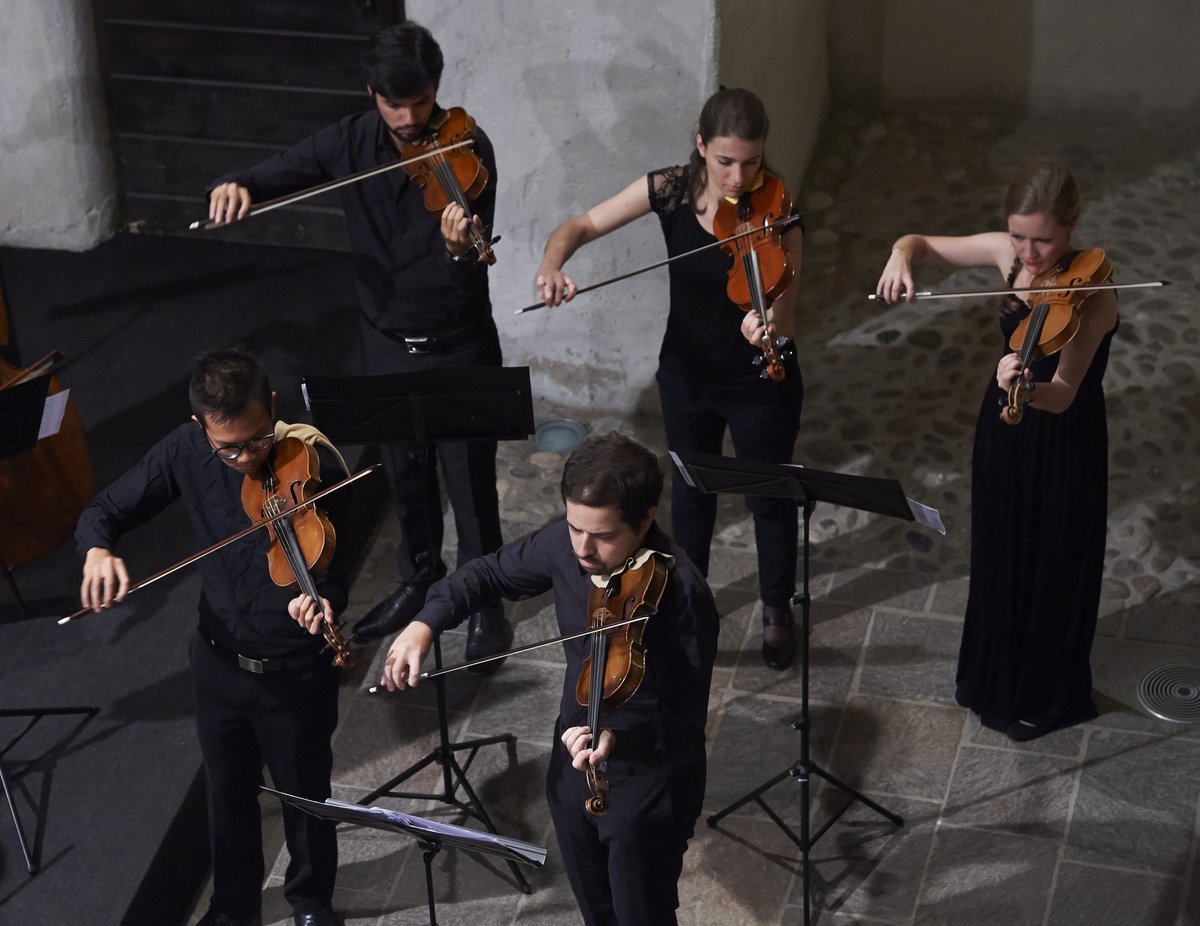
The Academy will end on Saturday 19th with a concert at Sala Rivolta (Teatro alla Vigne) in Lodi. Our musicians will perform part of the program studied during the Academy: the first of three pieces will be the Quartet in D by Giuseppe Maria Cambini, performed by Samuel Casale (Italia) – flute, Gemma Longoni (Italia) – violin, Alaia Ferran (Spagna) – viola and Bartolomeo Dandolo Marchesi (Italia) – cello. Next will be the Flute Quartet by Joseph Martin Kraus, played by Eva Ivanova-Dyatlova (Russia) – flute, Abel Balazs (Portogallo) – violin, Gabriele Toscani (Italia) – violin, Ania Wieczorek (Polonia) – viola and Martyna Jankowska (Polonia) – cello. Last but not least, Luigi Boccherini’s Quintet G337 will end the concert, played by Gabriele Toscani (Italia) – violin, Sophie Simpson (UK) – violin, Elena Gelmi (Italia) – viola, Giulia Gillio Gianetta (Italia) – cello, Lino Mendoza (Messico) – double bass

Theresia, a dip in chamber music

By theresia - April 17, 2018
A glance to the program of our next chamber music Academy

A glance at the program of our next chamber music Academy

Our first residency is going to start in a few days: it will be a string Academy devoted to chamber music and will be held in Cressia (France), with the violinist Chiara Banchini and the cellist Gaetano Nasillo as tutors.

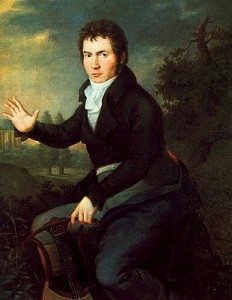
Portrait of Beethoven as a young man

Let’s give a look to the music program. We will start with Beethoven’s String Trio op. 9 n. 3, the last of a set of three string trio composed by Beethoven in 1797-1798. It is written in C minor, and it brings the most energy and novelty with highly passionate tone.

This trio invokes those later works’ power and peculiar character so typical of Beethoven. Dynamic effects, sharp contrasts in rhythm, harmonic confrontations among other means of music provide momentum and the tone of anxiety. By contrast, the Adagio brings peace and resignation in C major, with a more lively episode in E flat major in the middle of the movement. Both the Scherzo and the Finale continue the passionate and energetic storm of the first movement.C minor is one of Beethoven’s most important keys. Three of his piano sonatas and the fifth symphony were written in C minor, for instance. Then we have Luigi Boccherini‘s String Quintet in D major op. 39 n. 3 G 339, in which he deployed the distinctive combination of two violins, viola, cello, and double bass; this quintet is the third of a set of three. Boccherini was an incredibly prolific composer, and he wrote also over one hundred string quintets for two violins, viola and two cellos (a type which he pioneered, in contrast with the then common scoring for two violins, two violas and one cello). In op. 39 n. 3 the cello has often a prominent and challenging role; and very particular indeed is the twangy guitar effects in the finale.


Boccherini’s Quintet op. 39 n. 3 performed by Ensemble 415. Violins: Chiara Banchini and Enrico Gatti; Viola: Emilio Moreno; Violoncello: Käthi Gohl; Contrabass: Cléna Stein

Last but not least, even if not so well known, is the String Quintet in G major n. 23 by Giuseppe Maria Cambini: anyone who thought Boccherini was the first purveyor of string quintets with two cellos, would be wrong. Giuseppe Maria Cambini (1729–?83) was 14 years Boccherini’s senior and wrote 114 of them, a number that may actually exceed that of his younger compatriot. Both men were born in Italy, Boccherini in Lucca, Cambini in Livorno. But other than the commonality of their birth country, their careers took them in very different directions.

Boccherini, as we know, headed to Madrid, where he was employed by the Infante Luis Antonio, younger brother of King Charles III.  Cambini located in Paris around 1770, but wisely did not seek royal patronage in a monarchical succession that would soon enough disappear. Instead, Cambini managed to make it on his own, concentrating mainly on the writing of more than 600 purely instrumental works. Although it must be said that Cambini played little part in the radical musical developments of the Classical period, his music is richly textured, mellifluous, agreeably harmonized, and lengthily worked out.

Theresia’s strings will perform the musical program Saturday evening in Dole (France). Download here the program!

Enchanting Classicism

By Emilia Campagna - November 13, 2015
Let's deepen the program of the next concerts thanks to the listening guide by Paolo Motta

Enjoy the accurate listening guide that Paolo Motta wrote for Theresia’s concert in Lodi.

Carl Philip Emanuel Bach was the second, and probably the most famous, of Johann Sebastian Bach’s twenty sons. Since 1740 he had been harpsichordist in the music chapel of the Prussian King Frederick the Great: he performed with the king, who was an excellent amateur flutist. In 1768 he succeeded Telemann as musical director and Kantor in Amburg Johanneum. He was a prolific composer and a point of reference for Haydn and Mozart. He was highly appreciated also by Beethoven (mainly for the harpsichordist opus), and then by Mendelssohn, Schumann and Brahms.

During Theresia concert we will listen to the E minor Symphony Wq 178, one of the nine “Berlin Symphonies”: it was originally composed for strings, and later enriched with the addition of flutes, oboes and horns. It was composed in 1756 and it consists of three movements: at first, an Allegro full of tension, as rarely happened at that time; at the end, a second Allegro very rhythmical. In the middle, a delightful Andante, quite contrasting, a fine example of “gallant style”, to which the sound of flutes gives a particular taste.

Johann Christian Bach was the eleventh son of Johann Sebastian and his second wife, Anna Magdalena. After his father died, when JC was fourteen, he moved to Berlin where he stayed with his brother Carl Philip Emanuel and studied Harpsichord and Composition. In 1754 he left Berlin and traveled to Italy: he studied in Bologna with Padre Martini and in Milan with G. B. Sammartini. After he converted to Catholicism, in 1760 he became main organist in the Milan Cathedral. In 1762 he left Milan, for reasons that remained obscure: he moved to London, where he lived till his death and where he had a huge success (also in the field of opera, as a follower of Neapolitan school) becoming chapel Master of Queen Charlotte. Yet, his luck did not last long and he died before time and overwhelmed by debts. His music is far away from his father’s style and from CPE’s style too, due to the more relevant melodic principle. In any case, he is considered one of the most important composers of his time: he wrote principally in the gallant style, even if he is included among the main precursors of the Viennese classicism. He had a huge influence on Mozart.

The “simphonie concertante” is a typical form of the Classical period, and it can be described as a mixture between a symphony and a concert: it’s a concert because it has more than a soloist, and it’s a symphony because soloist are not in particular emphasis, except in few moments. The masterpieces in this genre were written – coincidentally… – by Mozart and Haydn. The Symphonie concertante C44 for flute, two violins, cello and orchestra opens with a lively introduction: then, the two violins and the cello are put in relief, often exchanging solos; in the Andante the flute is the absolute star, exposing sweetly sorrowful melodic lines. The Finale (Allegro Molto) is definitely more symphonic.

“L’isola disabitata” (“The uninhabited island”) is an opera composed by Franz Joseph Haydn in 1779: according to music historians, it represents the composer’s attempt to abandon the Italian “opera seria” style and update his style on the model carried forward by Gluck. The opera wasn’t successful, not at its time, neither in later reprises. Yet the Overture stayed firmly in the orchestral repertoire, due to the dramatic atmosphere and the characteristics that make it like a miniature Symphony, split in four sections with alternate fast and slow movements.

Luigi Boccherini was a great cellist and a prolific composer: he is considered the most representative composer of instrumental music in Latin European countries during the first Classicism. After some experiences in Vienna, Rome and Paris, he moved ultimately to Spain, into the service of Infante Don Luis: when Don Luis died, he establishes a long-distance relationship with Frederick William II, King of Prussia, for whom he composed a lot of music, including – in 1789 – the Symphony in D op. 42. It’s a composition of huge dimensions, with a wind section larger than the usual: it consists in flute, two oboes, two bassoons and two horns. The opening Allegro has a rather dramatic tone and is based substantially on a unique theme that develops through different combinations of instruments in dialogue one with each other. The Andante is particularly interesting, mainly for winds, with flute in evidence, while the strings provide a support made of emphases and brief interludes of dramatic recitative type. The Minuet is rigorous in the structure and in the rhythmical pattern: it’s in the Haydn’s style, with sharp moments for violin and bassoon. The final Presto is a lively, rhythmically engaging, with a clever dialogue of strings and horns.


The summer of Theresia: what are they going to play?

By theresia - August 15, 2015
Insights on the music that TYBO will perform in Bozen and Toblach

The program that Theresia will perform in Toblach and Bozen is entirely devoted to two of the most important composers of the late eighteenth century: Carl Philipp Emanuel Bach and Luigi Boccherini. Musical storiography and also performers have often considered them as less important composers. But the truth is that, despite a certain isolation, both of them had a great influence, each one in his own way, on composers of the following generation. The concise G major Symphony Wq80 that Theresia will perform first was composed by Bach in Zittau in 1758. It is a very successful example of Bach’s symphonic style: we found masterfully melted structural elements (the three movements are linked and are supposed to be performed seamlessly) and narrative elements, that are enlighted by the “enpfindsam” nature of the musical style.

E flat major Concert Wq47 is the last instrumental composition by Carl Philipp Emanuel Bach: he composed it when he was 74, in the last year of his life (1788). This concert is undoubtfully the most famous composition written for both harpsichord and fortepiano, two instruments that, in the modern thought, appear to be like competitors and chronologically distant: but as a matter of fact, they coexisted in concert halls till the beginning of XIX century. Mozart himself performed his concerts with harpsichord in the mid-eighties while, in the same years, performing with fortepiano or harpsichord was immaterial. Bach’s musical writing demonstrates this claim, because language is the same for both: fortepiano and harpsichord converse with each other using the same texture and the same frames, without departing from a thread that focuses on the musical meaning, and deliberately leaving aside the dualism between harpsichord and fortepiano.

Boccherini’s late symphonic production is well represented by concise D major Ouverture (1790), one of the most celebrated works for orchestra, and by enchanting D major Symphony nr. 27 G520, written for Prussian King Wilhelm II in 1789. This very composition is a work of great interest with both structural and narrative elements modern and experimental, mostly in the last movement (Presto). The symphonic idea is here very close to an advanced concept, like the contemporary Viennese symphonic style of Mozart and Haydn.

Theresia e il Settecento nascosto

By Emilia Campagna - July 17, 2015
“Carl Philipp Emanuel Bach e Boccherini sono due autori spesso considerati minori; eppure sono due tra i più importanti compositori di fine Settecento, ed hanno avuto molta influenza sui compositori della generazione successiva.”

Carl Philip Emanuel Bach e Luigi Boccherini: sono questi gli autori a cui si dedicherà Theresia nel suo stage estivo e nei concerti in programma a Bolzano e Dobbiaco. Nella scelta del repertorio il direttore artistico Mario Martinoli ci riserva sempre grande raffinatezza e scelte non scontate, come ad esempio l’importante lavoro che l’orchestra sta facendo in questi anni su Martin Kraus, il contemporaneo un po’ misconosciuto di Mozart. Per quanto riguarda il programma dell’estate, in cui l’orchestra lavorerà sotto la guida di Chiara Banchini, Martinoli spiega che “Carl Philipp Emanuel Bach e Luigi Boccherini sono due autori spesso considerati minori sia dalla storiografia musicale sia dagli interpreti; eppure sono due tra i più importanti compositori di fine Settecento, e nonostante un relativo isolamento hanno avuto molta influenza, in ambiti differenti, sui compositori della generazione successiva.”

Cosa ci riserva il programma?

Carl Philip Emanuel Bach

Carl Philip Emanuel Bach

“La breve sinfonia in sol maggiore Wq180 che apre il concerto fu scritta da Bach a Zittau nel 1758. Opera tripartita, costituisce un esempio assai ben riuscito del sinfonismo di Bach, dove si fondono con maestria elementi strutturali – i tre movimenti tra loro collegati e da eseguire senza interruzione – ed esigenze narrative, evidenziate dalla natura marcatamente empfindsam del discorso musicale.”

Di C. P. E. Bach ascolteremo il Concerto in mi bemolle maggiore Wq47 per clavicembalo, fortepiano e orchestra, una vera rarità: qual è l’interesse principale di questa composizione? “E’ l’ultima composizione strumentale scritta da Carl Philipp Emanuel Bach a 74 anni, nell’anno della sua morte, avvenuta nel 1788. Questo concerto è senza dubbio il più celebre esempio di opera scritta per cembalo e fortepiano, due strumenti che, nella ricezione moderna, appaiono tra loro concorrenti e cronologicamente separati, ma che in realtà hanno convissuto nelle sale da concerto fino agli inizi dell’Ottocento: lo stesso Mozart eseguiva i suoi concerti al cembalo ancora a metà degli anni ’80 e, negli stessi anni, era prassi consueta eseguire un’opera sull’uno o sull’altro strumento, indifferentemente. Il tipo di scrittura adottato da Bach per questo concerto ne è la dimostrazione: il linguaggio musicale scelto per i due strumenti è il medesimo, il fortepiano ed il clavicembalo dialogano utilizzando le stesse forme e le stesse strutture, senza discostarsi da un fil rouge che privilegia il discorso musicale, lasciando volutamente irrisolto il dualismo tra cembalo e fortepiano e mantenendolo in secondo piano.”

E per quanto riguarda i brani di Boccherini?

Luigi Boccherini

Luigi Boccherini

“Il tardo sinfonismo di Boccherini è ben rappresentato dalla breve Ouverture in re maggiore (1790), una delle sue opere orchestrali più famose, e dalla meravigliosa Sinfonia numero 27 in re maggiore G520, scritta per il Re di Prussia Federico Guglielmo II nel 1789. Un’opera, quest’ultima, di grande interesse e dai contenuti strutturali e narrativi moderni e sperimentali, soprattutto nel Presto finale, che curiosamente ritroveremo dieci anni dopo nelle prime opere sinfoniche di Beethoven. Una composizione assai vicina ad una concezione sinfonica già avanzata e certamente paragonabile al coevo sinfonismo viennese di Mozart e Haydn.”

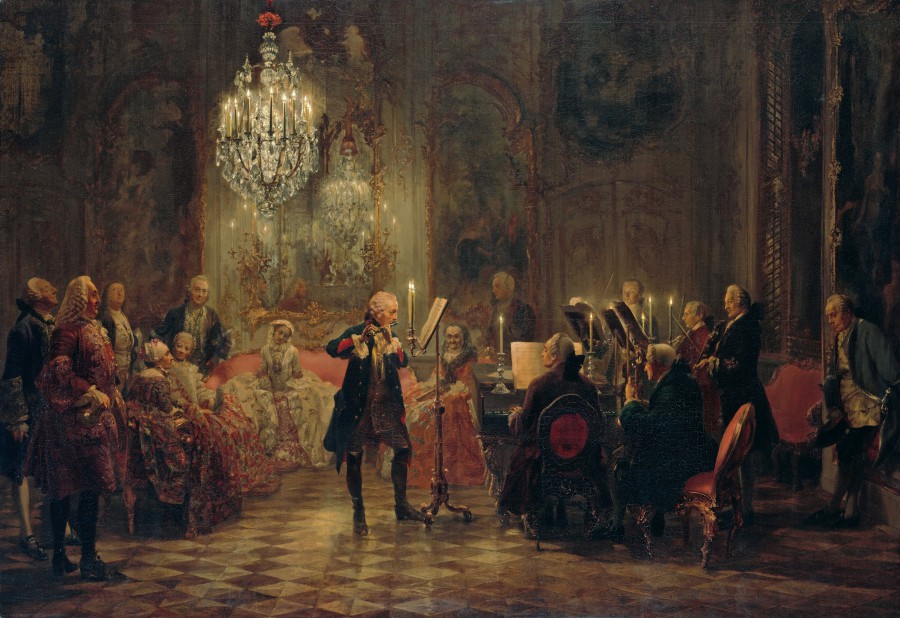
Federico il Grande di Prussia suona il flauto accompagnato da C.P.E. Bach al clavicembalo (dipinto di Adolph Menzel)