Meet Theresia: Jonathan van der Beek

By Emilia Campagna - May 31, 2022
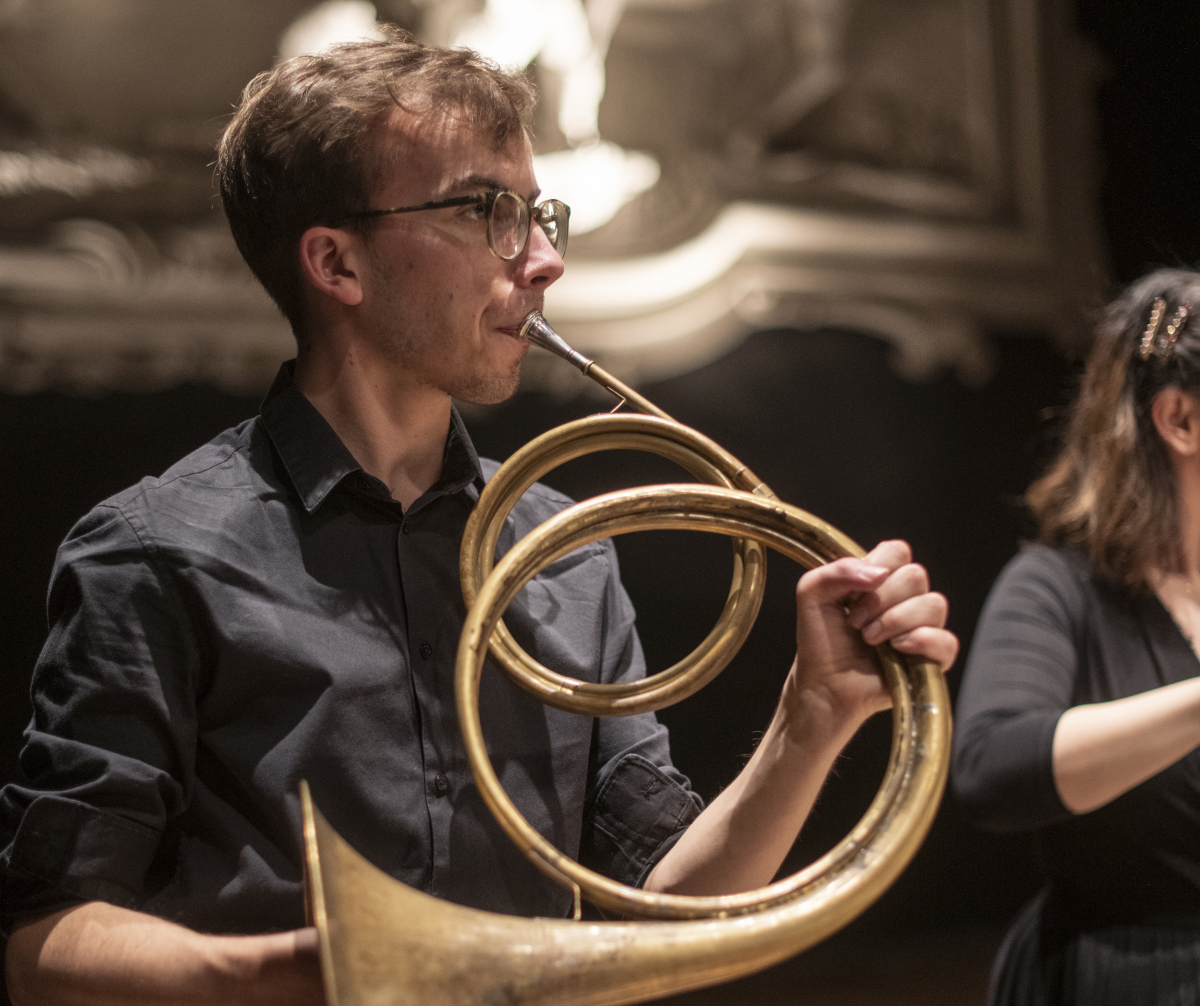
Does every musician remember how they fell in love with their instrument? Belgian horn player Jonathan van der Beek does: find more in the new interview of the Meet Theresia series.

Jonathan van der Beek, Belgian horn player, joined Theresia in 2021: let’s find something about his passion for music, his experience and his expectations.

Tell us something about your musical story: how did you start playing and when and why did you decide to focus on the historical instrument?

I wanted to play the horn from a very young age on – I think that happened when I was four years old. My parents had this CD from Peter and the Wolf (Prokofiev) where the horns represent the wolves. I fell in love with the warm sound of the horn and when I was old enough, I immediately started in the music school. My first teacher in music school, who would be my horn professor in the Conservatory later on, was a horn player but also a phenomenal natural horn player. I listened a lot to his CD’s where he plays the natural horn, and that’s why I have always been interested in it. I started studying the modern horn but when the Coronavirus crisis left us all without any goals I decided to enrol for an audition and start practising the natural horn. Furthermore, I fell in love with the instrument and its sound. Some months later I played my first projects on natural horn, and nowadays I am very happily combining modern horn with the natural one.

How did you know about Theresia?

The first project I ever played on natural horn I played together with Rodrigo Lopez Paz who told me about Theresia. I went to search for Theresia on the internet, and it seemed like an opportunity I didn’t want to miss. So, I signed up for the audition.

You auditioned for Theresia in the summer of 2021: how was it, and which pieces of advice could you give to some colleagues of yours who may take part in the next auditions?

The only advice I can give is that you should really go there! Normally, an audition is a quite frightening and sometimes disappointing experience. In the case of the Theresia audition, this was exactly the opposite. It is called an audition because they are making a selection in the end, but it felt more like a workshop or even a masterclass in a beautiful environment. We got to prepare certain pieces, and we had to ‘rehearse’ in front of a jury the whole day. This made me very comfortable as I wasn’t judged only on the 5 first minutes of playing. When I went out of the audition, I was just so grateful that I got the opportunity to work with Alfredo Bernardini and all the great musicians that participated. If I were not selected, I would still take this great experience home.

You took part in the latest project, a wind academy with tutor Alfredo Bernardini. How was it? What did you like more about this experience?

I had a great time at the wind academy, especially because the group of musicians and friends we played with was so close. We had a lot of fun playing the music, but also outside the rehearsals. I like very much that we got the opportunity to play 4 concerts in 4 different cities. It was exciting to have to deal with another acoustic every time.

You worked with Maestro Bernardini both in an orchestral and in a chamber music project: which was the difference between the two experiences?

Both times were unforgettable experiences, but there was a clear difference; Alfredo was really the conductor in the orchestra project, while he was more like a coach in the wind project. I really like his way of working and experimenting with the group of musicians he works with. This was similar during both projects.

During the residency, you were presented with the EMPOWER project, an initiative funded by the EU: what do you expect from it? How do you think working with Theresia can “empower” you?

Foremost, I want to say that Theresia already empowered me in developing my skills as an instrumentalist. About the particular EMPOWER project: I am looking forward to gaining more knowledge in the domain of historical informed performance, and I am also interested in the more ‘economical’ subjects of the course. I think this combination of residencies with the orchestra, chamber music projects and specific courses in domains where I am very much interested in, will empower me the next years as a musician, thanks to Theresia Orchestra.
 

New auditions for TYBO

By theresia - November 7, 2013
Do you want to be a TYBO musician? New auditions are scheduled on 31th January and 1st and 2nd February in Bolzano (IT) Which instruments? Violin
, viola, contrabass
, trumpet, clarinet, bassoon
 and horn! Here are all the informations: https://theresia.online/new-auditions/

Do you want to be a TYBO musician? New auditions are scheduled on 31th January and 1st and 2nd February in Bolzano (IT)

Which instruments? Violin
, viola, contrabass
, trumpet, clarinet, bassoon
 and horn!

Here are all the informations:

https://theresia.online/new-auditions/

New auditions for violins, cellos, basses, oboes, traversos, basoons and horns!

By theresia - March 6, 2013
The THERESIA Youth Baroque Orchestra (TYBO) organises a series of auditions to recruit young musicians for the orchestra in preparation of the 2013-2015 productions, remunerated concerts and stages. Core of the TYBO programs is the classical repertoire (1750-1800) played on period instruments (A=430Hz). VENUE AND SCHEDULE The audition will be held in Bolzano (Italy) on […]

The THERESIA Youth Baroque Orchestra (TYBO) organises a series of auditions to recruit young musicians for the orchestra in preparation of the 2013-2015 productions, remunerated concerts and stages.

Core of the TYBO programs is the classical repertoire (1750-1800) played on period instruments (A=430Hz).

VENUE AND SCHEDULE
The audition will be held in Bolzano (Italy) on Saturday 20th April and Sunday 21st April 2013.

Detailed information on venue and performance timing will be notified to all participants in due time.

INSTRUMENTS
The audition is open to the following baroque instruments:
– violin
– cello
– contrabass
– traverse flute
– oboe
– bassoon
– horn

ADMISSION REQUIREMENTS
The audition is open to professional musicians (including advanced students) born after 1st January 1982.
In-depth knowledge of performance praxis on authentic instruments is a mandatory requirement.

APPLICATION
Participants shall send an email to *auditions@theresia-project.eu* containing:
– name
– surname
– date and place of birth
– nationality
– physical address
– email address
– phone number
– detailed CV
– scanned copy of passport or identity card.

DEADLINE
Applications must be sent to *auditions@theresia-project.eu* not later than Sunday 14 April 2013.

SELECTION COMMITTEE
Claudio Astronio, permanent musical director of TYBO.
Esther Crazzolara, first violin of TYBO.
Luigi Lupo, traverso player.
Mario Martinoli, founder and artistic director of TYBO.

AUDITION PITCH
The pitch for the audition is A=415 Hz.

SCORES
The candidates are warmly invited to bring with them the full scores, or piano reductions, of the pieces they intend to play in the auditions.

ADMISSION RULES
A maximum number of 45 musicians will be admitted to the audition.
In case of the reception of more than 45 applications, the 45 younges musicians will be admitted, provided that the audition shall include:
– At least 3 applicants per instrument
– All applicants resident in the regions Trentino, South Tyrol or Tyrol.

***PROGRAM OF THE AUDITION***

VIOLIN

1) W.A. Mozart, Symphony n. 41 in C major K 551 “Jupiter”, 4th movement

OR

W.A. Mozart, Symphony n. 39 in E-flat major major K 543, 3rd movement, Finale (first part only)

2) Two movements (in total) at choice and contrasting in character from F.M. Veracini, Sonate Accademiche and A. Corelli, Sonate a violino e violone op. 5

3) Two movements at choice from W.A. Mozart sonatas for violin and piano (cembalo).

4) Sight reading.

BAROQUE CELLO

1) F.J. Haydn, Concert for cello and orchestra in C major, 1st movement.

2) Two movements at choice and contrasting in character from F.S. Geminiani, Sonatas for cello and continuo op. 5.

CONTRABASS

1) J.S. Bach, Concerto in a minor for 2 violins BWV 1043, 1st movement

2) J.S. Bach, Matthäus Passion BWV 244, 1st movement, opening choir “Kommt ihr Töchter”.

3) W.A. Mozart, Symphony n. 35 in D major K 535 “Haffner”, 1st and 4th movement

TRAVERSO

1) J.S. Bach, Sonata in E major BWV 1035, 1st and 2nd movement

2) C.P.E. Bach, Two movements contrasting in character at free choice from any of the concert for traverso and orchestra

OBOE

1)J.D. Zelenka, Sonata n. 5 in F major ZWV181, 2nd and 3rd movement (first oboe)

OR

J.S. Bach, Brandeburg Concerto n. 2 in F major BWV1047, all movements.

2)L.A. Lebrun, Concerto n. 1 in d minor, 1st movement (pitch A=430 Hz allowed!)

OR

C.P.E. Bach, Two movements contrasting in character at free choice from any of the concert for oboe and orchestra

BASSOON

1) W.A. Mozart, Concerto in B-flat major KV191, 1st movement

2) J.D. Zelenka, Sonata n. 5 in F major ZWV181, 1st and 2nd movement

HORN

1) J.S. Bach, Brandeburg, Concerto n. 1 in F major BWV 1046, all movements

2) W.A. Mozart, Concert n.4 in E-flat major KV495, 1st movement

3) L. van Beethoven, Symphony n, 7 in A major op. 92, 1st movement (first horn)

INFORMATION
More information on TYBO and the auditions will be available at www.theresia-project.eu and on the TYBO Facebook page.