The Eroica, in ten voices

By cristina liotta - August 2, 2026
Chiara Banchini tells the story of Theresia's next chapter in Geneva: how chamber music becomes a way to rediscover the great symphonies and set them travelling again.
‍

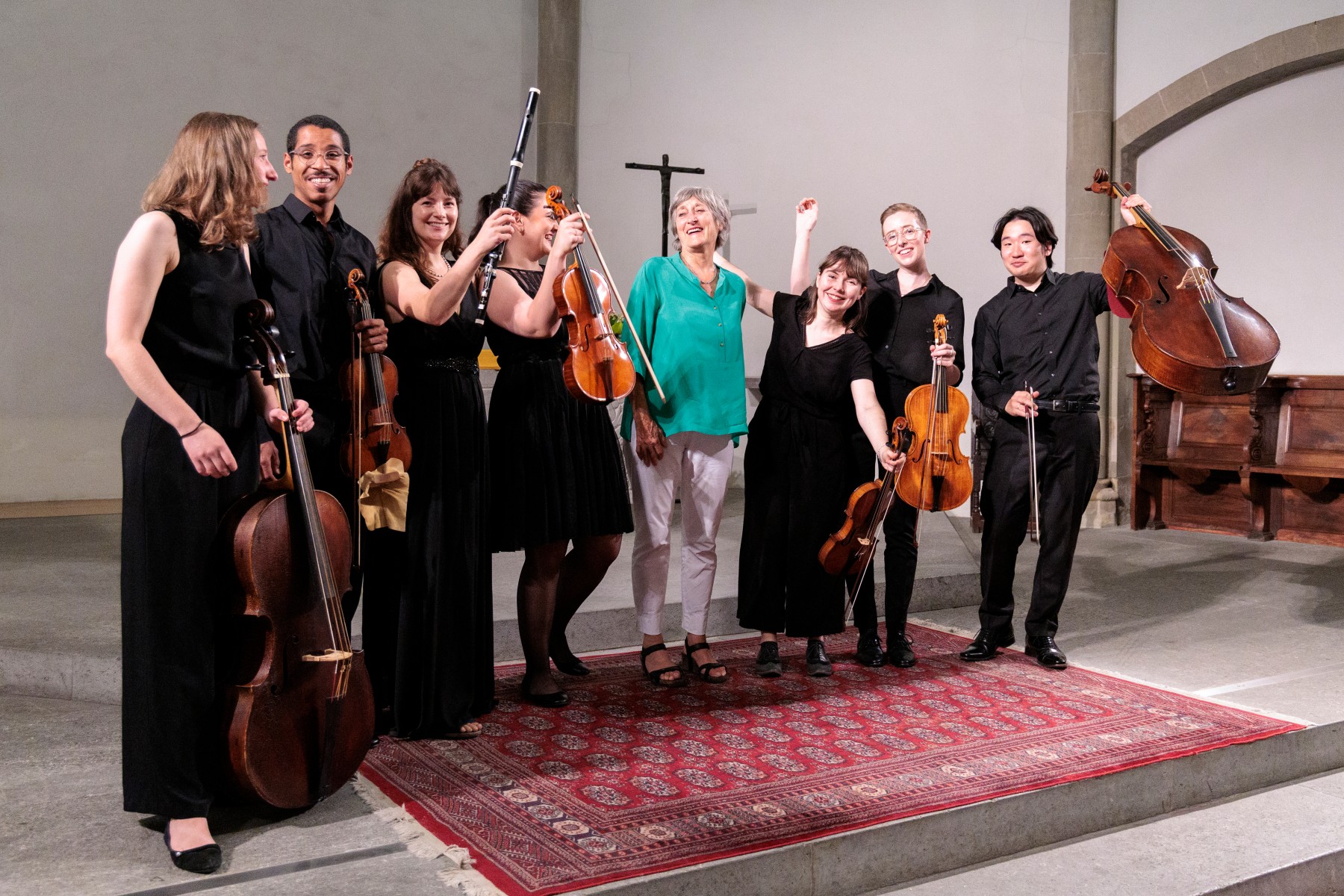
Every summer for the past seven years, Theresia has climbed up to Geneva’s Vieille Ville for two evenings at the Église St-Germain. In these occasions, the orchestra gathers around a chamber-sized stage. The bond with the Concerts d’été à St-Germain began in 2019, when Chiara Banchini, newly on its artistic committee, brought a proposal to the table.

A cycle born from a conversation

The idea, Banchini says, came the way good ideas do: from a conversation.

“Mario Martinoli came to Geneva, we talked at length with the committee, and out of that came the idea of a cycle devoted to Beethoven’s symphonies in reduced scoring. The committee loved it, so we decided to do one each year.”

And this year, that bond reaches one of its most demanding point: Carl Friedrich Ebers’s chamber arrangement of the Eroica, Beethoven’s Third Symphony recast for a handful of instruments, a highly ambitious step in the Beethoven cycle we have been building here since 2022.

It is worth pausing on why. A symphony in reduced scoring sounds, at first, like something has been taken away. But fewer players mean nothing is hidden: every line has to be heard, every player is exposed, and the audience sits close enough to follow the music thinking itself through. What the committee recognised was that this is not a smaller Eroica but a unique way of listening to this masterpeace: a nearer and more intimate one, and a church seating a few hundred people is exactly the right frame for it.

A fixture in the Geneva season

The choice has practical roots as much as artistic ones. St-Germain cannot hold a full orchestra, and the festival has always made room for young performers — of its nine concerts each season, two or three go to young groups or soloists, often from Geneva, often competition winners. Theresia sits exactly between those two things. And here is the heart of it: Theresia exists to bring the symphonic repertoire to life, music that normally asks for an orchestra. The Beethoven cycle is how we carry that heritage into a church where this music cannott be heard usually — and towards listeners who come looking for something more intimate than the great concert halls and symphonic works.

“The Concerts d’été à St-Germain have run for fifty-two years, always in the same church. When the programme is drawn up, people say: there, a Theresia concert. It’s a fixture, perhaps the only one alongside the winner of the Concours de Genève.”

Theresia began as an orchestra of young professionals gathered from across Europe and playing on period instruments as they were in use during the Classical period, when this music was written. The orchestra has no fixed home: each project is built with a network of partners, and in Geneva this year the players come together for a full residency. That international, hands-on formation is part of the point. Banchini, who taught for years at the Schola Cantorum Basiliensis in Basel, Europe’s leading centre for early music studies, sees residencies like this as where young musicians put training into practice.

She is also clear-eyed about where early music stands, and adds a positive note to the discussion about classical music education and early music.

“Look at the conservatoires today — the early-music departments keep growing. Period instruments for early music, modern instruments for modern music: in my day this wasn’t done, now it’s natural, no longer an exception.”

The 2026 programme: Gyrowetz and the Eroica

Alongside the Eroica comes a Serenade in E-flat major, Op. 3 No. 1 by Adalbert Gyrowetz — a Bohemian composer who built his career in Vienna, and of whom relatively little is known today. It is a genuine piece of Harmoniemusik, the wind music of late-eighteenth-century Viennese salons and gardens: the same intimate sound world from which the chamber transcriptions of the great symphonies would soon emerge. Think of it as the evening’s opening door — the room the Eroica will walk into.

The Eroica is where the cycle asks the most, of the players and of us.

“It’s one of Beethoven’s most incredible symphonies, almost an hour long. In four days of rehearsal we have to arrive at a truly compelling moment, because the Eroica speaks to everyone: it draws both attention and the heart.“

Why an Eroica chamber arrangement, today

There is a second reason the concert matters, and it lies in Ebers’s arrangement itself. Chamber transcriptions, extremely rare in today’s programming, were once how music travelled: without recordings or an orchestra always at hand, reducing a symphony to seven, eight, ten instruments was often the only way to bring a work like the Eroica to the people who wanted to hear it.

“I’ve never heard it in concert myself — none of Beethoven’s symphonies reduced this way. Winds and strings together make a sound far clearer and plainer than the one we know. And these are transcriptions made in Beethoven’s own day, not ours — that matters.“

That last point is what makes the arrangement valuable: it shows how musicians of Beethoven’s own time heard and understood this music. And reviving it now does something to the listening, too. When the forces shrink, the symphony comes into focus. The inner voices return one by one. Strip away the orchestral mass and the compositional thinking lies exposed: the interplay of voices, the harmonic choices, the way an idea passes from one instrument to the next a phrase you have heard a hundred times suddenly arriving from a single bassoon.

The great-hall Eroica and this one are two different experiences. The second is intimate and transparent, and closer to the work as it was made.

A training ground for young musicians

The reduced ensemble also changes what is asked of each player. With ten instruments, no one can lean on another stand: each part covers the role of several from the original, carried with a soloist’s responsibility and a chamber musician’s ear. The very practice that once sent symphonies out into the world becomes, here, how a new generation is formed.

“Ours isn’t an audience that rushes to hear the Eroica in the great halls, and it values hearing it somewhere more intimate. People ask me which symphony is next, or tell me they’ve never heard it like this. There’s a real appetite for the symphony in reduced scoring.“

For whoever leads a project like this, preparation is almost double: you have to know the orchestral score by heart in order to teach the parts.

“I need to know the orchestral Eroica by heart to work out how to coach the players.“

We look very much forward to the evenings of 2 and 3 August, for this next stage of the Theresia Beethoven cycle in Geneva.
Theresia in Geneva 2026:
Le Salon de Beethoven at St-Germain

By cristina liotta - June 16, 2026
Theresia returns to the Église St-Germain for the latest chapter of Le Salon de Beethoven, the cycle celebrating Beethoven’s symphonic works through historic chamber music transcriptions.
‍

Some encounters become a tradition. The story of Theresia in Geneva is one of them: the collaboration began in 2019, when violinist Chiara Banchini joined the artistic committee of the festival Concerts d’été à St-Germain and proposed it. Since then, our orchestra has been a regular guest of the historic series.

On Sunday 2 and Monday 3 August 2026 at 6:30 PM, a chamber formation of Theresia in Geneva will return to St-Germain with Le Salon de Beethoven. The programme opens with Adalbert Gyrowetz’s Serenade in E-flat major, Op. 3 No. 1. and closes with Beethoven’s Symphony No. 3 “Eroica”.

The 2026 edition Musique et transcendance takes place at the Église St-Germain in Geneva, the historic venue that gave the festival its name.

Le Salon de Beethoven: the next chapter of our journey

This cycle explores the historic practice of reimagining symphonic masterpieces, originally written for full orchestra, for chamber ensemble, offering a more intimate perspective on monumental repertoire as understood by the musicians of the composers’ own time.

In 2026, the journey reaches its fifth chapter with Beethoven’s Symphony No. 3, “Eroica,” presented in the chamber arrangement published in 1818 by Carl Friedrich Ebers.

The 2026 project is artistically curated by Chiara Banchini. She prepares the ensemble and shapes its interpretive approach. This continuity has given the Geneva residency its distinctive identity within Theresia‘s season.

More details about this residency, the origins of this musical practice, and its role in disseminating the symphonic masterpieces we still listen to today will follow in the coming weeks.

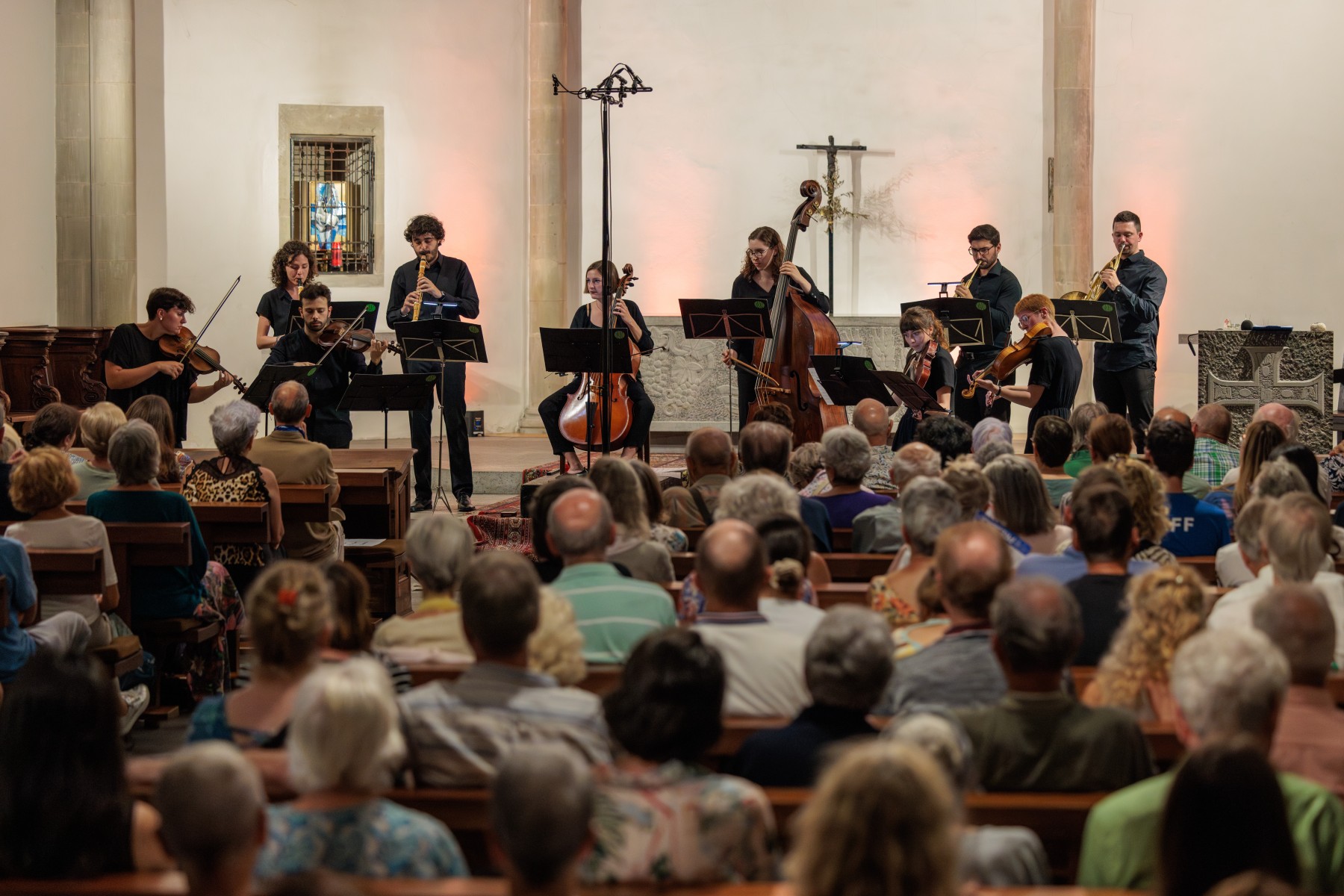
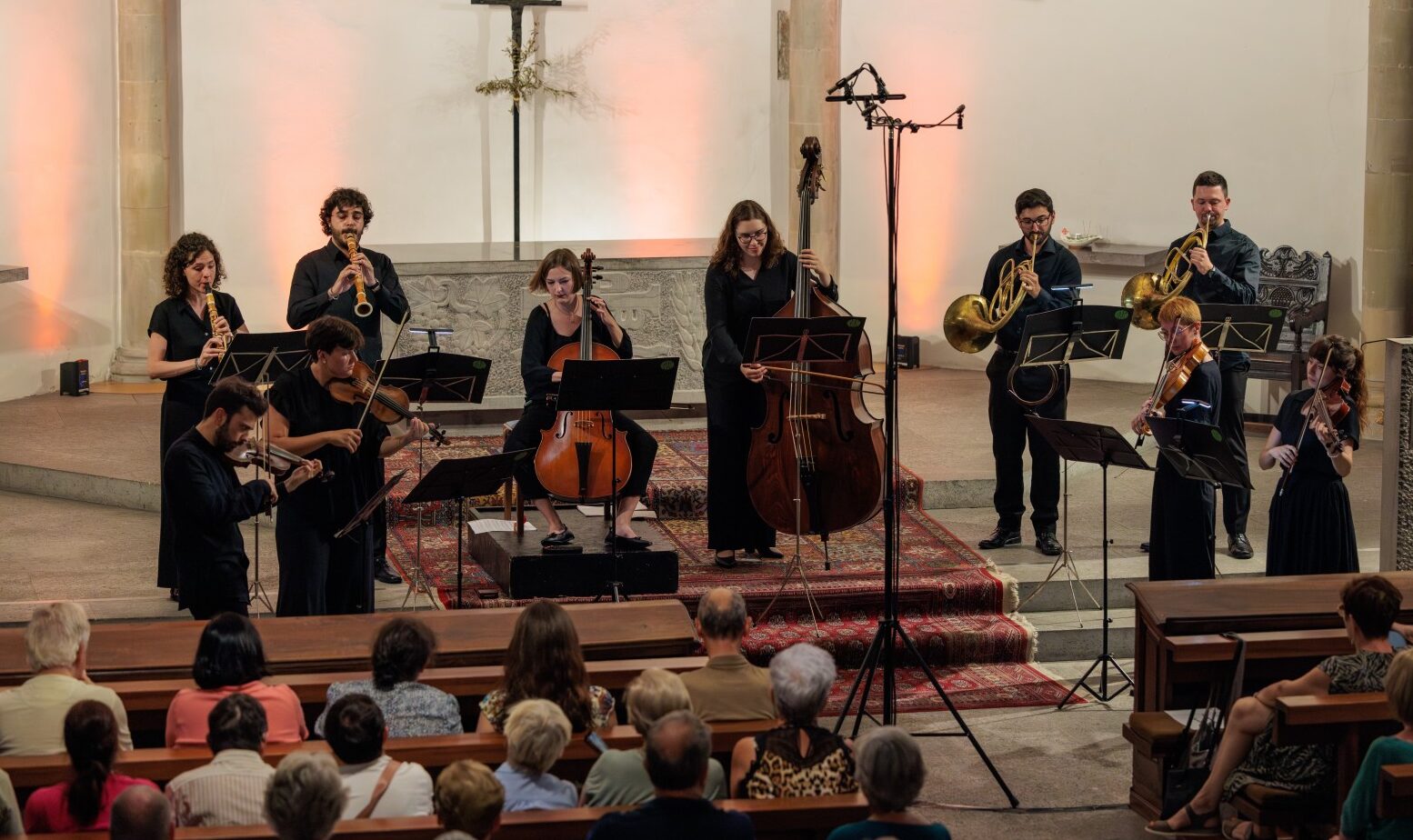
Theresia in Geneva 2026 — chamber formation at Église St-Germain


Simone Laghi guides us in the discovery of two hidden treasures

By Emilia Campagna - July 18, 2023
Although very different, the programmes for our next two projects have one thing in common that is very important to us. Both the historical chamber music transcription of Beethoven's 7th Symphony and Traetta's oratorio Rex Salomon have been critically edited by Simone Laghi, Scientific Advisor of Theresia, who gives us an interesting insight to these hidden treasures.
‍

Theresia musicians have two big events coming up this summer: a chamber music residency in Geneva -a welcome return – led by Chiara Banchini from 24-31 July, and an orchestral production as guests of the Early Music Festival in Innsbruck conducted by Christophe Rousset, from 12-18 August, performing with the NovoCanto choir.

Although the programmes are very different (music by Beethoven and Boccherini in Geneva, music by Tommaso Traetta in Innsbruck), they have one thing in common which is very important to us. The core of the Geneva programme, a historical chamber music transcription of Beethoven’s Seventh Symphony, and Traetta’s oratorio Rex Salomon were both critically edited by Simone Laghi, Scientific Advisor of Theresia, with whom we’ve had a brief interview.

Simone Laghi, let’s start with Beethoven’s Seventh Symphony in the transcription for flute and string sextet. What can you tell us about this work?

The transcription was written by Nicolas Mori, an Italian-English violinist who was active in London in the first half of the 19th century. This type of transcription was very common in Europe at the time, to bring symphonic and orchestral works into a chamber dimension (and thus for domestic performance). In this case, it is a very interesting work, especially for the ensemble used, namely flute and string sextet (specifically two violins, two violas, cello and double bass): there are no particular changes in the writing, the flute takes over the role of the wind parts, sometimes flanked by the second viola.

How did you get to work on this transcription and edit the critical edition?

In my research at Cardiff University I dealt with the string quartet repertoire of early 19th-century Italian composers active in London, so I came across the work of Nicolas Mori. A few years ago I had the opportunity to edit the critical edition of this transcription, which was then published by the HH publishing house. However, I believe that Theresia’s is the first performance in modern times. There are, however, other interesting transcriptions by Mori, such as those of Beethoven’s Overtures: unfortunately the double bass parts are missing, so it is impossible to make a critical edition for now.

Beyond the existence of this ‘English’ transcription, is there a relationship between Beethoven and London?

Absolutely. We know, for example, that Beethoven composed the Ninth Symphony at the invitation of the London Philharmonic Society: it is true that the first performance took place in Vienna, but then the Symphony was naturally performed in the English capital. And then it seems that Beethoven had planned to go to London, as Haydn had done years before, but it never actually took place.

Now let’s talk about Traetta’s Oratorio “Rex Salomon”, which Theresia will perform on 18 August as part of the Innsbruck Early Music Festival: what do we know about this composition?

The Rex Salomon was composed by Tommaso Traetta in 1766 to be performed at the Ospedale dei Derelitti in Venice by the ‘Putte’, i.e. the girls residing in this charitable institution. Precisely because it was intended to be performed within the Ospedale dei Derelitti, the vocal ensemble is female only, making it a rather special work within this genre.

What was the occasion for the composition?

Rex Salomon was composed to be performed on the Feast of the Assumption, 15 August 1766. On this particular occasion Traetta had the task of restoring the former glory of the Ospedaletto’s orchestra and choir, which had been neglected in recent years and were experiencing a period of decline. With this oratorio, which was performed four more times in the following ten years, he succeeded in doing so, even though we are in the last years of the glorious history of the Serenissima: with 1797 and the fall of the Republic, even the musical vitality of realities such as the Ospedaletto dei Derelitti faded away.

How did the ‘Putte’ become part of the orchestra and choir?

Often they were girls who had been taken in as children because they were orphans, but in many other cases they were so-called ‘adult daughters’ who were taken in because of their musical merits: it was not easy to get in, the selection process was quite strict. Nor was it easy to get out, because once these talented young girls had been trained, the institution wanted to keep them. Those who managed to pursue a musical career on their own had to do so outside Venetian territory, or if they performed in the city, they did so in secret and under a false name.

What is the source on which you have based the edition from which Theresia will perform?

It is a manuscript kept in Brussels and part of the Fétis collection: this important musicologist, who lived in the 19th century and was the author of a monumental Encyclopaedia of Music and Musicians, probably bought the manuscript on the antiques market, and it is a somewhat unusual piece in the collection. Moreover, the manuscript refers to the last performance, that of 1776, which Traetta partially revised because one of the singers, originally a alto, had been replaced by a soprano.

What are the musical characteristics of Rex Salomon?

The main peculiarity is the vocal ensemble, which is necessarily all female. There is a certain complexity to the writing, although it is far from the excessive virtuosity typical of the theatre of the time. However, there is still a great deal of coloratura and a certain amount of elaboration, a sign that the level of the performers was quite high and that they were addressing an audience with high expectations. It is curious, and gives us a measure of a peculiar situation, that each of the five soloists has two arias, so there is no measurable hierarchy in the increasing number of arias according to degree of importance. The instrumental part, especially the first violins, is also well worked out, detailed in its articulations.

There is a fine record of the very first performance, a letter written by the philosopher Giammaria Ortes to the composer Johann Adolph Hasse on 16 August 1766: “Yesterday I went to a new musical oratory at the Ospedaletto, and I have realized how, without singing well, one can still avoid singing poorly, and how in similar conservatories, the combination of docility and moderate skill can provide more pleasure than abundant skill combined with presumption. If these girls continue in this manner, this could be the case in which music, having generally fallen into the excess in which it currently resides, returns back to that mediocrity that constitutes its perfection.”

Simone Laghi is Sicentific Consultant of the Theresia Orchestra and a digital communication expert. He holds a PhD in music performance from Cardiff University. He has a background as professional musician in the historical performance practice field, and he has collaborated with a large number of groups and ensembles in Europe. He has produced and organised recordings. He has published several musical editions of eighteenth-century works, and has written articles and editorials for Ad Parnassum, Early Music Performer, and Eighteenth-century Music.