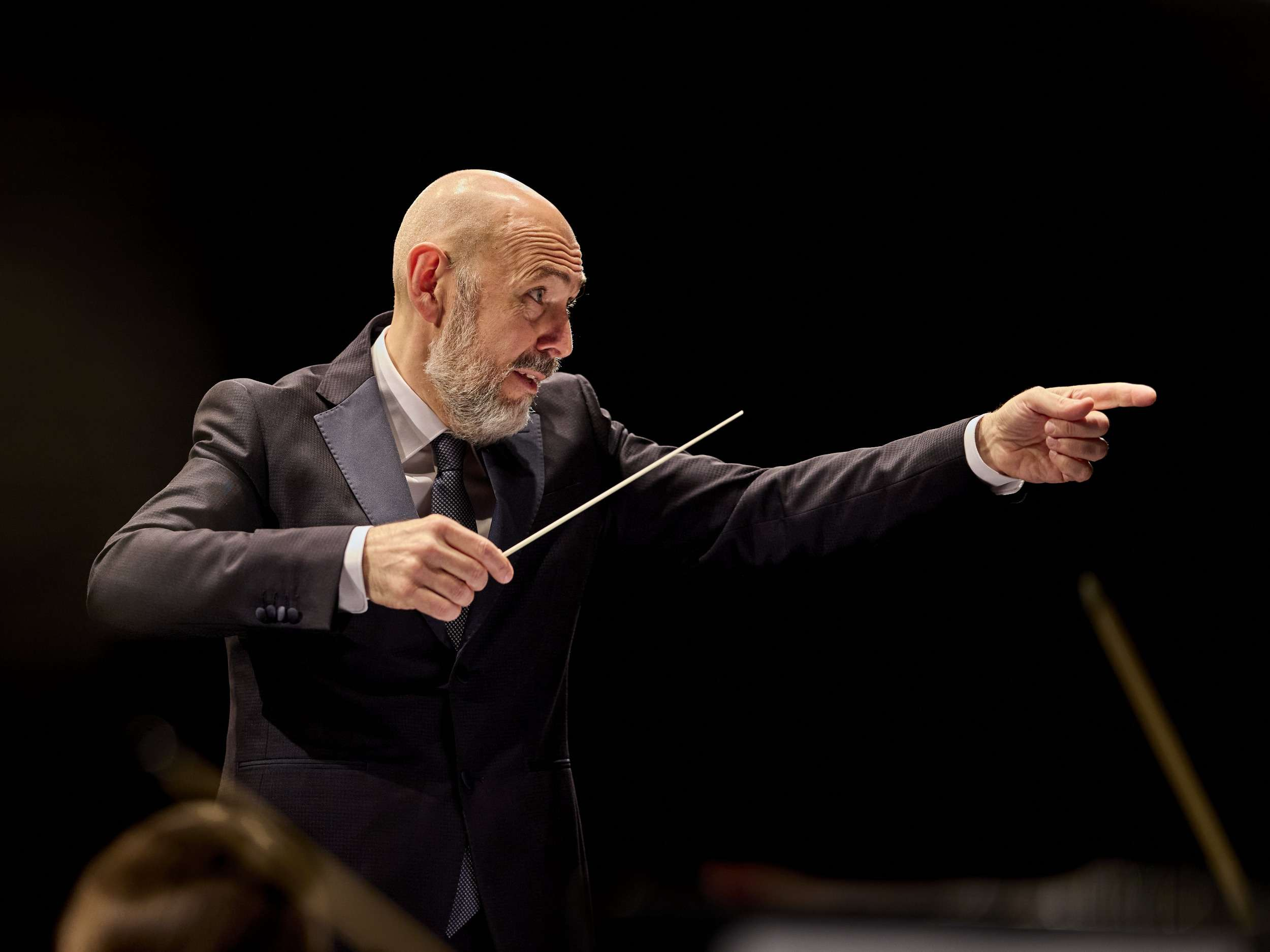
Maestro Enrico Onofri, you will conduct Theresia Orchestra in a programme entirely dedicated to Mozart, with performances of his first and last symphonies: how does it feel to perform two compositions that represent the beginning and culmination of Mozart’s art up close?
Juxtaposing Mozart’s first and last symphonic works – hence the title of the program, “Mozart, Alpha & Omega” – was an idea that had been in my mind for some time. Not to compare their style and content: in fact, it would be a sterile operation without being able to examine simultaneously the entire path that Mozart travelled in the twenty-four years between his First Symphony and the “Jupiter”. However, I thought it would be interesting to demonstrate to the audience how the quality of writing and musical ideas – despite the enormous difference between the two works – remains a constant of the composer, from his childhood to the last years of his life. There is also a small curiosity that unites them, which has sparked speculation, but is the result of a coincidence due to the contrapuntal pattern in one of the movements of the piece, rather than Mozart’s specific intention, and thus a purely programmatic divertissement: In the Andante of the First Symphony, the theme of the final movement of the “Jupiter” Symphony appears, entrusted to the horns, which is also the theme of the Credo of the Mass, KV197, itself taken from a Gregorian motif – in the case of the Mass, however, the connection with the “Jupiter” is probably no coincidence.
Also on the program is the Serenade K. 100: for what occasion was this piece composed, and which ‘Mozart’ are we listening to?
We do not know the specific occasion for which this work was written, but it was certainly for a celebration or an open-air event in Salzburg, as with most of his serenades. K100 is one of the earliest works in this genre, whose structure resembles that of a symphony enriched with many movements, intended to entertain the patron’s guests. In the Serenade K. 100 we can already recognise the characteristics of the later, more famous serenades, namely the “Posthorn” and the “Haffner”, and it offers us a brief glimpse into the complex journey of Mozart – who was just 13 years old when he composed K. 100 – that I mentioned earlier.
For the first time, you will conduct Theresia, an orchestra founded 12 years ago with the aim of performing classical repertoire on original instruments. How do you view this artistic project?
The Age of Enlightenment is undoubtedly the turning point that made Europe into what it is today. As an artist, if I had only one hypothetical opportunity for time travel, I would want to experience the years around the turn of the century to learn from figures such as Mozart, Beethoven, and Goya. The classical repertoire is highly formative and educational, both in terms of its content and its instrumental demands. As a student, I trained as a violinist and chamber musician mainly on the classical repertoire, as well as on the romantic and twentieth-century repertoire, which in some way extends or transforms its language. I therefore consider it an invaluable opportunity for these young musicians to immerse themselves in this music, and to do so on historical instruments, which allows them to engage with it on an even deeper level.
Theresia is a youth orchestra consisting of musicians up to the age of 28. Do you often work with youth orchestras? What do you enjoy about it, and how does it change your approach?
I have been combining my career as a conductor with working with youth orchestras and teaching for twenty-five years now, for example as a mentor and conductor of the EUBO (European Union Baroque Orchestra) or the youth orchestra of the Academia Montis Regalis. It is an essential part of my journey as a musician, because in giving to young people, I receive just as much from them: a youth orchestra, with its energy and thirst for knowledge, is in some way a generative mirror of ideas and freshness, enriching the musicians as much as it enriches me. In terms of the way I work, I do neither more nor less than I would with a ‘professional’ orchestra: conducting, especially when it comes to historically informed practices, naturally has a strong didactic element, but with young people, I also have the added responsibility of training them in an ethic of playing together, and helping them understand the valuable contribution this ethic makes to our lives, not only in music.
Where were you, and what were you doing when you were at the age of our Theresians?
When I was nineteen, I became first violinist in Savall’s orchestra for a short time, before moving to Milan to continue my traditional studies. After various experiences with both pioneers of historically informed performance and with musicians from different backgrounds, at twenty-four I recorded the complete Op. 8 of Vivaldi with the Giardino Armonico for Teldec – including “The Seasons”, an album that in some ways marked a milestone in the journey of historically informed music. That same year, I also performed with the Concentus Musicus Wien under Harnoncourt. The following year, I recorded the complete Brandenburg Concertos of Bach as a soloist, while also working with the likes of Gustav Leonhardt…. In short, I have been very fortunate.
Theresia will be performing in Nova Gorica, a city that, until a few years ago, was divided by a wall from its “sister” city across the border, Gorizia. In a world surrounded by conflicts and divisions, is it just rhetoric to say that music transcends borders, or is it still true?
Certainly: music is a powerful ‘bulldozer’ for breaking down walls, as well as the best way to connect souls in difficult times. As a convinced Europeanist, I am very much looking forward to conducting in Nova Gorica, a symbolic city in the journey of our continent.
The final concert takes place in Nova Gorica, the Slovenian city designated as the European Culture Capital in 2025. Find out more here!