Every year on April 22, Earth Day marks the anniversary of the birth of the modern environmental movement in 1970.
What is Earth Day?
More than 50 years ago, a group of activists led by U.S. Senator Gaylord Nelson launched the movement in the wake of a natural disaster, the devastation of a massive oil spill in Santa Barbara, California in January 1969. On 22 April 1970 more than 20 million people took to the streets: the first Earth Day remains the largest single-day protest in human history and it achieved a rare political alignment. In 1990, Earth Day went global, mobilising 200 million people in 141 countries and bringing environmental issues to the world stage. Over the course of decades, Earth Day has drawn hundreds of millions of people into the environmental movement, creating opportunities for citizens to engage and volunteer in more than 193 countries.
Today, Earth Day is widely recognised as the largest secular observance in the world, marked by more than one billion people each year as a day of action to change human behaviour and forge policy changes at a global, national, and local level.
How Theresia embraces the philosophy of Earth Day
Earth Day calls people to action: we can all do something for the planet, by starting to change habits that are no longer sustainable. Of course, this also applies to Theresia! With the help of project manager Veronica Meneghello, our Corporate Social Responsibility (CSR) expert at ICONS, we asked ourselves how we could improve our impact as an orchestra and developed a scheme that aims to raise awareness among our musicians and offset their emissions.
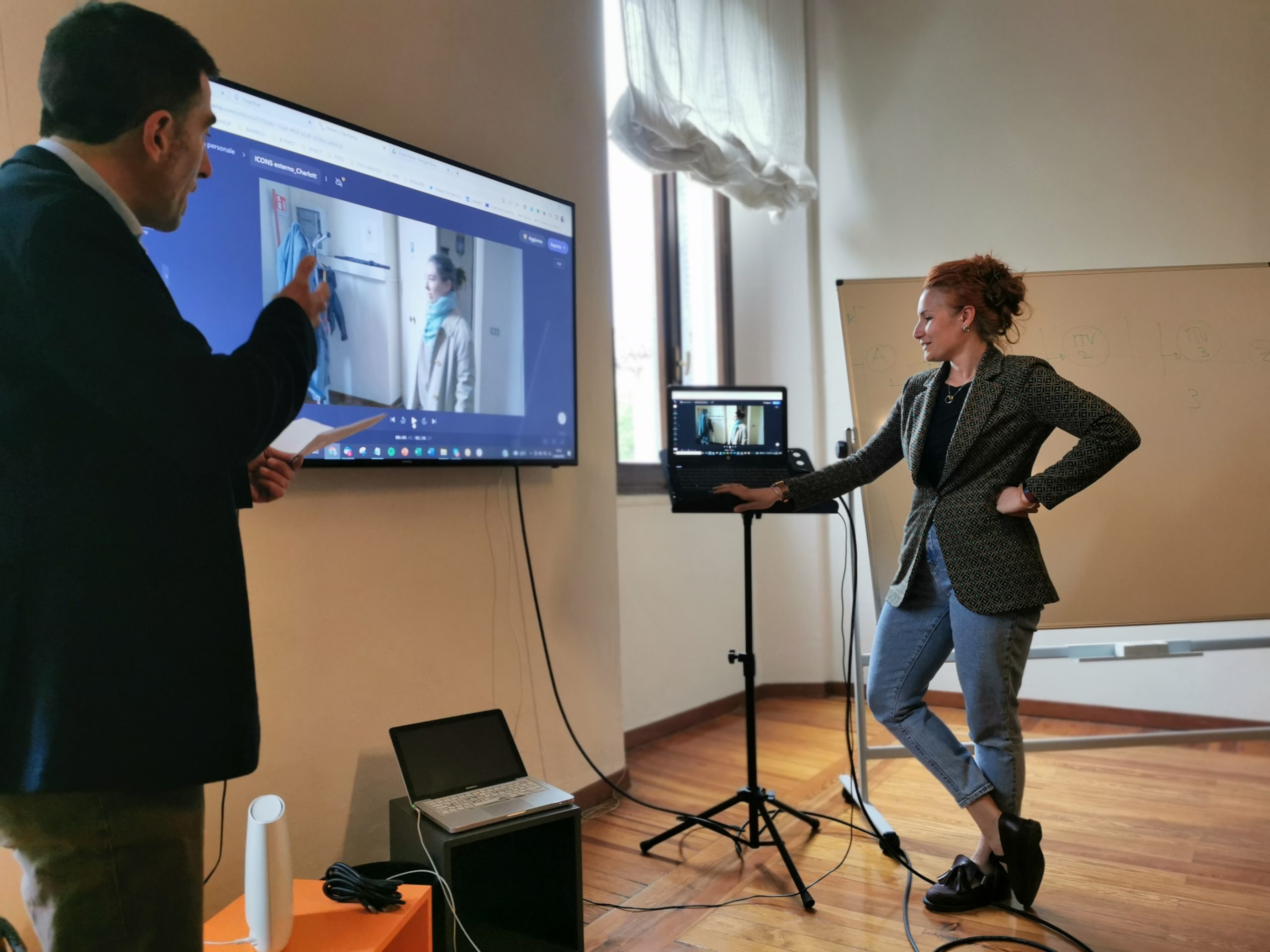
We decided to dedicate one of the training modules we offer our musicians to sustainability and ecological transition as part of our capacity-building activities, a programme at the heart of the European funded EMPOWER project. ICONS’ CSR and project manager Veronica Meneghello tell us more…
How do sustainability and ecological transition issues fit into EMPOWER’s capacity building?
We decided to start by raising awareness of sustainable mobility, since travelling, especially long distances, is a fundamental part of musicians’ professional lives, and of sustainable behaviour in general in everyday life. Therefore, on the one hand, the aim is to encourage the players to reduce their ecological footprint and, on the other hand, to inform them about offsetting, namely the possibility of offsetting emissions that cannot be avoided. We created an interactive presentation with quizzes and videos to facilitate understanding of the topic and commissioned an external provider to create a digital guide explaining in detail the two aspects of reduction and offsetting, and outlining the offsetting projects available through EMPOWER.
What does Theresia’s “carbon offsetting activity” consist of?
After the training on carbon offsetting, we moved on to practical implementation. ICONS collaborates with a supplier to offset emissions from orchestra travel. The calculation is done on an annual basis and includes all travel, both from each individual musician’s home to the concert residency and any travel within the residency itself. The musicians who have participated in this year’s residencies are given a personal code through which each of them can offset their emissions, choosing to allocate them to one of the six projects proposed by the provider, which can be environmental (e.g. reforestation actions) or social (e.g. implementation of renewable energy, or training actions).
About 140 musicians got involved, and you met them partly in person and partly online. How was their response to the initiative?
They were quite aware of sustainability and impact issues, but were not very familiar with the fact that the ecological footprint can be quantified objectively, which they found very interesting. Some were a little sceptical about offsets, which is normal: these are issues that create mistrust if you don’t know how these offsets are used in practice in projects, but we deliberately involved our provider to illustrate the different possibilities and also to explain that offsets are not the solution, but only a temporary measure.
When did you first become involved in this topic, and is there a bearing on other ICONS projects?
I have a master’s degree in Environmental Economics and continued with a master’s degree in Sustainability in Law, Finance and Management. With the consent and participation of ICONS management, I started a CSR unit – Corporate social responsibility – at ICONS: we are about to launch a working group on gender equality and are also working on projects that include CSR. Offsetting is potentially applicable to ICONS as well, to compensate for all the travelling that is being done for projects, but currently this is not the case. EMPOWER could be a first experiment and then be extended to the rest of the organisation some time soon.
You can follow the progress of the offset program here. And talking about sustainability, clean energy, and climate change, how much do you know about that? Take the quizzes on the Earth Day website and test yourself!