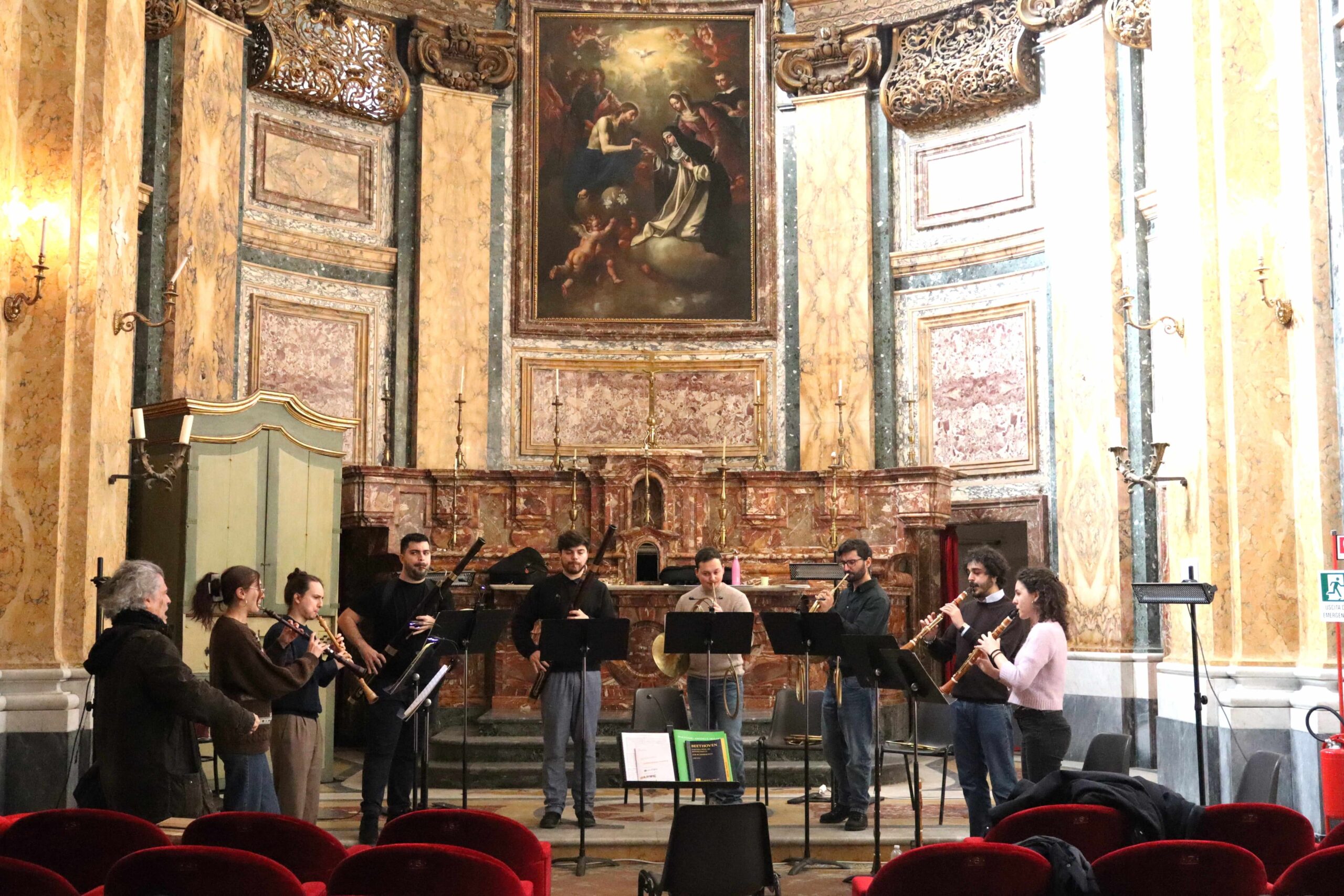
Two Italian cities will frame the next chapter of Theresia’s activities in 2026. At the conclusion of a Wind Academy led by Lorenzo Coppola, Theresia Harmonie – the wind section of Theresia Orchestra – will perform in Naples and L’Aquila, presenting the results of an intensive residency devoted to Harmoniemusik from the Classical repertoire.
From 16 to 22 February 2026, the musicians gather in Naples for a working period centred on stylistic refinement, ensemble balance and historical awareness. As in all Theresia residencies, the Academy is conceived as a space for growth: young professional players specialising in period instruments deepen their understanding of the musical language that shaped Europe’s cultural enlightenment between 1770 and 1810.
The programme is dedicated to Harmoniemusik, the wind ensemble formation that flourished in the eighteenth century. As Simone Laghi explains, “The name Harmoniemusik derives from the fact that, at the dawn of the Classical era, within the orchestral context, wind instruments were entrusted with sustaining the harmonic foundation of the pieces. They compensated for the gradual disappearance of basso continuo instruments, assuming responsibility for weaving the chordal texture upon which the string melodies unfolded. With the technical advancement of wind instruments and the increasing virtuosity of ever more specialised musicians, this ensemble gradually achieved a degree of independence, supported by the development of a vast repertoire specifically composed for it.” Becoming a vialble alternative to the orchestra, the repertoire also embraced arrangements of operas, ballets and symphonies, making it a crucial vehicle for the circulation of the symphonic imagination.
The musical programme reflects this historical perspective. Franz Krommer’s Partita in B-flat major, Op. 78 represents a composer who, at the turn of the nineteenth century, enjoyed remarkable fame throughout Europe. Mozart’s Le Nozze di Figaro, presented in Johann Nepomuk Wendt’s arrangement, belongs to a tradition in which transcriptions are not simple reductions, but true instrumental reinterpretations of operatic masterpieces, balancing fidelity to the original with idiomatic adaptation for winds. Beethoven’s Octet in E-flat major, Op. 103, written before his move to Vienna, already reveals more compact sonorities and a breadth almost orchestral in scope, anticipating the large-scale symphonic architectural thinking of his maturity while retaining the brilliance characteristic of courtly entertainment.
The ensemble brings together young musicians from across Europe and beyond: oboists Phyllis Breit (Austria) and Amadeo Castille Vidonne (France); clarinettists Luigi Giannini (Italy) and Carolina Guiducci (Argentina/Italy); bassoonists Luis Tasso Athayde Santos (Australia/Brazil) and Carlos Bertão (Portugal); and horn players Giacomo Giromella (Italy) and Sergio Notarangelo (Italy). Under Lorenzo Coppola’s guidance, they work towards a shared sound ideal rooted in historical awareness and collective discipline.
Residency in Naples – Fondazione Pietà de’ Turchini
The entire rehearsal phase and the first concert are hosted by Fondazione Pietà de’ Turchini in Naples, marking the first collaboration between Theresia and this long-established Neapolitan institution. Named after one of the historic Neapolitan conservatories, the Fondazione has become a point of reference for the research, production and dissemination of early music, with particular attention to the rediscovery of Neapolitan musical heritage.
Hosting the Wind Academy places Theresia’s work in dialogue with this tradition of research and transmission. Naples, a city whose musical life shaped European taste for centuries, offers a historically resonant context for a project devoted to stylistic clarity and the refinement of Classical language. The residency culminates in a public concert at the Chiesa di Santa Caterina da Siena on Saturday, 21 February 2026 at 7:00 PM.
For further information and tickets, click here
L’Aquila – Stagione Barattelli at the Auditorium del Parco
The residency concludes on Sunday, 22 February 2026 at 6:00 PM at the Auditorium del Parco in L’Aquila, within the Stagione Barattelli of the Società Aquilana dei Concerti “Bonaventura Barattelli.” Returning to L’Aquila carries particular meaning for Theresia. The orchestra has already performed at the Auditorium del Parco, a venue born from the dramatic events of the 2009 earthquake that struck the city and profoundly marked its cultural life.
Designed by Renzo Piano and inaugurated in 2012 under the direction of Claudio Abbado, the Auditorium was conceived as a place of symbolic and concrete renewal. Performing again in this hall situates Theresia within that continuing story: a concert venue built to safeguard musical life and to contribute to the rebuilding of community through culture. Returning within the Barattelli season reaffirms a shared commitment to artistic quality and to the continuity of concert activity in a space that embodies resilience and civic responsibility.
Discover more about L’auditorium del Parco and Theresia’s past visists to L’Aquila
Naples and L’Aquila thus mark two moments of the same artistic process: the concentrated work of residency and the encounter. Through this Wind Academy, Theresia Harmonie continues its exploration of the Classical repertoire, highlighting the role of the wind ensemble within the broader symphonic imagination of the late eighteenth century.
For further information and tickets, click here
Theresia Harmonie Wind Academy
21 February 2026, Chiesa di Santa Caterina da Siena, Naples, h. 19:00
22 February 2026, Auditorium del Parco, L’Aquila, h. 18:00

