Self-accompaniment – a historical approach (and personal path) to music making

By theresia - December 2, 2024
Orpheus. Apollo. Achilles. Troubadours. (Pretty much) every single music maker from antiquity up to the Romantic era would have done this. Ambassadress Anna Freer explores the fascinating word of self-accompaniment, past and present.

by Anna Freer

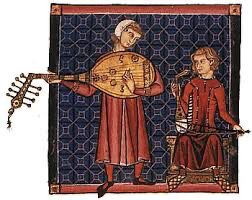
Self-accompaniment (the art of singing while playing an instrument, both activities happening at the same time) occupies a funny place in the ‘art music’ canon. In antiquity, it was something so common as to be never remarked upon as a practice in texts (in ancient Greece, there is a word psile-kitharsis, to denote solo playing on the kitharsis, a lute-like instrument, without singing). The same goes for music making in medieval times, where it was a matter of course for singers to accompany themselves with improvisations on a plucked or bowed instrument, through to the Renaissance and the baroque, where it is only documented in terms of ‘remarkable and astounding beauty’, as in the case of Tarquina Molza. (For more information on the topic, I’d really recommend reading the second chapter of Robin Tier’s The ideal Orpheus, an incredibly detailed look into the place of self-accompaniment in classical music!) Up until the late Romantic era, it was common for singers to accompany themselves on the piano in a salon or concert setting.

Fast forward to today, and the practice of self-accompaniment seems to have disappeared in classical (or ‘art’) music. We see it in pop music – it’s ubiquitous for artists who sing to either play the piano, guitar, or in the case of young guns like Laufey, the cello. We see it over and over again in folk music – Irish, Norwegian, Austrian, Romanian and American fiddlers and guitarists. Why have we lost it in classical music?

In my last article for Theresia’s blog, I detailed my preparation process for an international violin competition (read it here!) – its ups and downs, the lessons learned. The months on either side of the competition dealt with their own questions and brought me pause many times. It may sound pretentious and overblown, but going through the process made me think a lot about what it means for me personally to be a violinist and a musician.

Why have we lost self-accompaniment in classical music?

I grew up in a house with music as its heart and core, as two things – a reluctant violinist and an eager singer. Somewhere along the way (thanks to a fantastic mentor at a very formative time), the violin part became less reluctant and positively exciting, but going on choir camps and tours and eventually singing in an excellent chamber choir alongside my violin studies was a vital part of my musical life. Singing and singing together, making music with others using only the most basic instrument, was always to me one of the most magical things, human connection in a direct way through the heart and the voice.

I put the violin playing and the singing in two separate and very distinct boxes. As a young teen, I was told that The Choice loomed in front of me on whether to pursue violin studies or vocal studies. Obviously it wouldn’t work to do both at the same time – and to achieve a high level on both? Impossible.

This – the question of technique, brilliance, and virtuosity, is where we lost the practice of self-accompaniment. In the case of piano playing – a very common form of self accompaniment even through the 17th and 18th centuries, with Schubert himself playing the piano and singing in performances of Winterreise – the more complicated accompaniments became in song cycles, the more the ‘art’ side of both instruments was developed, the less common it became for a performer to do both at the same time. In violin playing, with the rise of virtuosic works from Paganini, Brahms, Wieniawski, Sarasate, Ysaÿe – the staples of ‘standard repertoire’ today – singing and playing at the same time became totally out of the question. The perfect execution and presentation of ‘masterworks’ rose to the forefront of how we view and consume classical music, and the space for a performer to accompany themselves, or for a family or group of friends to come together and make raucous happy music with both instruments and voices, became relegated to something of a curiosity, rather than a central aspect of music making.

The question then becomes – how has the shift from generalised music learning (for the soul, for connection, and as part of our daily life) to specialised music learning (purely as a higher form of art, practised by professionals) affected us all? Is it even something to consider or think about anymore? What is music for?

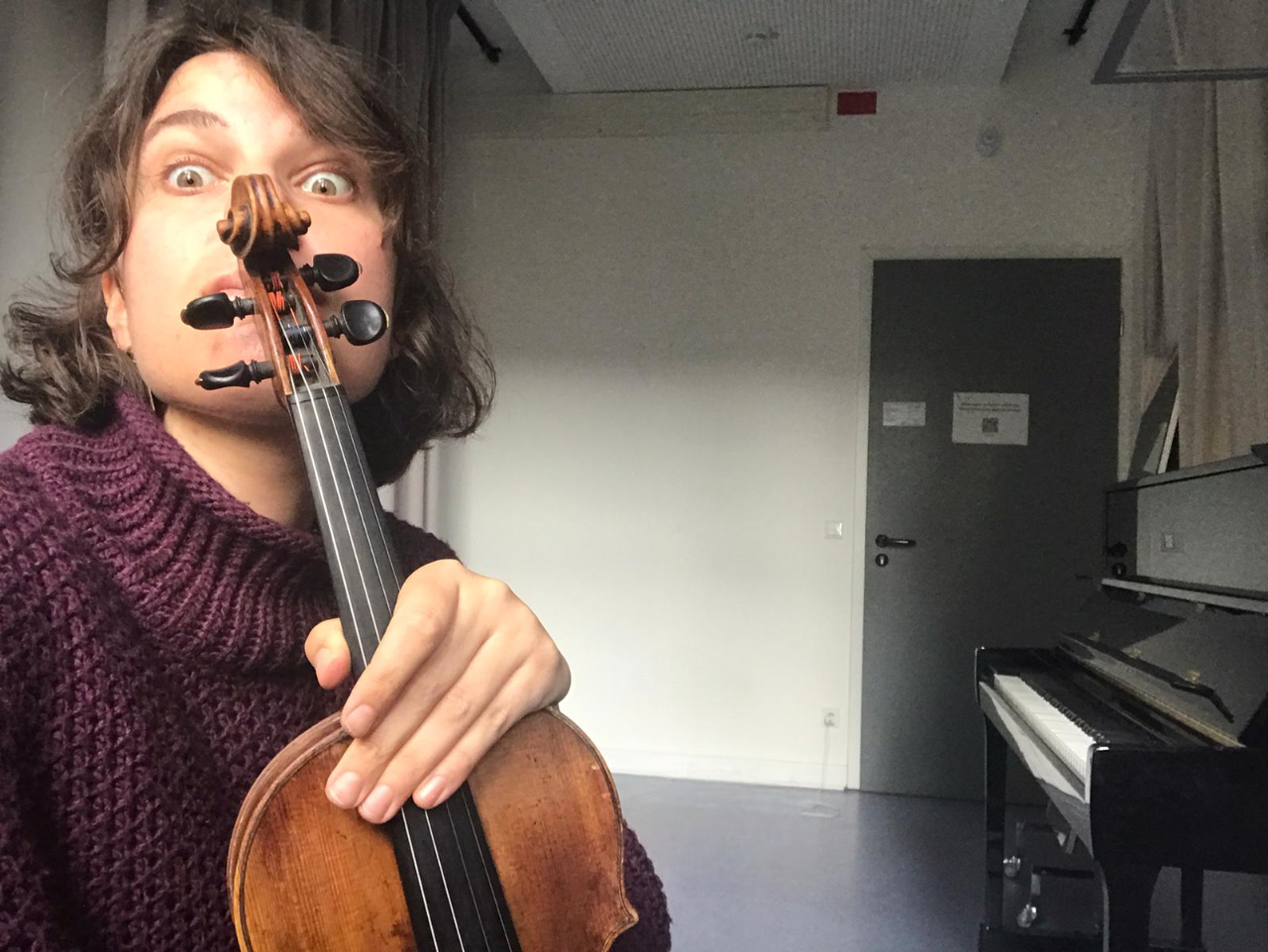
It was 2020 when I first experimented with singing and playing at the same time, with an incredibly beautiful chant from Hildegard von Bingen (that I still love to play today, and you can listen to here). I remember there being some sort of lightbulb moment – you can combine these! It might be possible! – and also feeling like both sides of my musical life were finally converging.

In the four years since then, I’ve experimented a lot more, with written song cycles from Vaughan Williams and Holst (here you can see a little excerpt from Vaughan Williams’ Along the Field), and making my own arrangements of folk songs and Renaissance motets. It has been an incredibly rewarding process and has expanded my musical horizons immeasurably to develop these skills hand in hand – to feel like I can tell new stories through this medium and that I am presenting myself as a whole through music. However – I come from a path of very specialised music learning. When I present concerts where I sing and play at the same time, it’s viewed by audiences as a curiosity, something extremely outside the box, something that’s not possible to achieve for people who haven’t had the same specialised music training. Is this true?

\

I’d like to think and say a resounding no to that. Playing and singing has been a part of music making since the very beginning, even if the playing aspect is simply providing a beat for yourself with body percussion. It develops our brains in bigger and more exciting ways (multitasking, two different stories going on at once), and gives whoever does it a huge feeling of accomplishment and fulfilment. With that end in mind, I’m in the process of developing a workshop in conjuction with Theresia’s Ambassadorship program and Raum236 in Zürich – SING-PLAY: FOR ALL. In the span of an afternoon, we’ll go through some singing basics, including how to connect to your voice and breath with movement, discover ancient examples of self-accompanied song, learn folk-songs with simple accompaniments (using instruments we have or body percussion) and end with singing and playing together at Raum236’s Classical Jam. It will be open to all experience levels, whether you play an instrument or not, and promises to be a really joyful event, mixing music making with human connection in a fresh and fun way. More details (date/time and how to sign up) will be released next week, so keep an eye out! In the meantime, I will leave you with some of my favourite examples of self-accompanied singing from contemporary, classical, and folk performers, and wish you a happy week:

Pekka Kuusisto – My Darling is Beautiful (folk song)

Abel Selaocoe – Kha Bohaleng

Concerto di Margherita – Io non compro piu’ speranza (Marchetto Cara)

Giovanna Baviera – Hor ch’el ciel e la terra

Katie Yap – Aftermath (Emily Sheppard)

Simon Svoboda – Kaamos

Rachel Fenlon – Come lovely and soothing death (George Crumb)

Bruce Molsky – Cotton Eye Joe

Nancy Kerr and James Fagan – Dance to your Daddy

Monique Clare – Hourglass

Orbis Quartett – Lu Mircato (folk song)

How I survived competition preparation

By theresia - October 28, 2024
A musical contest preparation can be overwhelming... but should it be? Theresia's Ambassadress Anna Freer recounts her own experience.

by Anna Freer

It was the beginning of July when I opened an email in my inbox I’ve never expected to see there…


C O N G R A T U L A T I O N S!

Your application to the International Max Rostal Competition

has been accepted – we look forward to seeing you in Berlin in October!


After a whole adult lifetime of insisting I’m not interested at all in competitions and everything they stand for, I have spent most of May preparing rabidly for the pre-selection round of this one. I send off the application video with a feeling of distinct relief – that’s done with. Now to enjoy summer – wait, what? The complete unknown of a new kind of preparation stage is about to begin.

The kind of intense preparation that musicians most commonly do for competitions and auditions is something of a loaded topic. When you make the choice to go down a slightly different path in your musical life, this becomes relegated to another world – of square perfection, of accuracy, of intonation intonation intonation. Paganini caprices and Ysaye sonatas played so cleanly you could eat your dinner off them, figuring out how to balance preparing the first round (the only guaranteed chance you have to play) with the recital round, the concerto round – it’s a whirlpool, a minefield for me, having spent the last years mainly concerned with finding my musical voice and programming recitals and concerts dynamically and interestingly, to give audiences new experiences of music. This is not to say that I haven’t been interested in – obsessed with – excellence. if something is to be new, dynamic, and interesting, it has to be executed at the highest level possible. But this, this? A competition? Sending the confirmation of my participation feels like jumping off a cliff where the sea below is just all the things I am most uncomfortable about in my violin playing.

Over-dramatic? Yes, very. Unfortunately that’s the only way I operate. But now, a few months away from July, and two weeks away (in the other direction) from Berlin, I can see the stages of grief preparation more clearly – for me, at least, they go like this.

One. Excitement

I can’t overemphasise how unexpected this was. I have never thought of myself as a violinist that competition juries would be interested in, so although I profess to think most competitions are rigged and a waste of time, progressing in one is a strange sort of validation. And a new experience! I vow to work as hard as I can and not be attached to the results, to use it to push myself as a musician. I vow to be balanced about the whole process. Famous last words.

Two. Trepidation

I’m going through the repertoire list – it’s big. Long. Virtuosic. A Paganini caprice in the first round, something I’ve always been too scared to play in public. A wildly varied recital in the second. A concerto I’ve not played before for the final. I make a plan, go home for the summer, my friends tell me they don’t want to see me until I’ve done my work for the day. I am still balanced!

The work proceeds – well, I think. I feel like I am coming to terms with the repertoire, waking early to turn on my parents’ loud old coffee machine before anyone else is up, spending the mornings with Schumann and the afternoons at the community garden watching my friends’ fearless toddlers climb trees. I play in all sorts of places – the church meeting room, my friend’s bar, a freezing hall in the hills. How exciting! How scary! It’s getting there. I come back to Zürich for lessons before the semester officially begins, and get through – for me – an astonishing amount of repertoire over three days with my teacher. We change a lot in the music, we work hard. I am so tired. I play it all directly after in a class lesson with all my colleagues listening, thinking not about the music but about the changes I have to make and how exhausted I am, how my body doesn’t feel like I am controlling it. I give up on myself and the music within the first two minutes and somehow still have to play for thirty more. It is an unmitigated disaster.

Three. Despair

This doesn’t last forever, just the week of the terrible class lesson, but it begins to tinge everything I do. My intonation is terrible. What’s the point in being a good musician if you can’t play in tune? The spiral begins, bringing not quite another stage, but a sub-stage:

Three-A. Obsession

I begin to sleep less but practice in a more desperate way. Balance? That was a nice concept for someone who had more time, someone who could play in tune, someone who wasn’t a disaster, someone who was on the way to executing the music like she heard it in her head. The whys began to pile on – not only why am I doing this competition, but more why am I playing this instrument, why am I banging my head against a brick wall? All the advice – from teachers, friends, myself, the internet, to sleep more, drink enough water, seem so stupid – still so much to do and all of it sounding bad.

I sleep through my alarm one morning, finally giving my body the break it’s screaming for. I wake with a twinge of…

Four – Surprise? Hope

Multiple rehearsals that day, one I am especially dreading with our class pianist for the concerto. To my shock, I find myself having fun, enjoying playing. Nothing is as bad as it had seemed the day before – it feels like my fingers have finally registered all the work I have been putting in. Maybe the stupid advice wasn’t so stupid after all – maybe water and sleep really do help (Nuh. Duh.)

This leads to where I am now, I think:

Five, Acceptance

I have begun, in small stages, to realise there is no point in flogging the horse of where I ‘should be’ in relation to this competition, in music and ability and comparison with others. Everything I play stands where it stands in this moment – ever able to be improved, ever changing, I hope, in the life in music I hope to have. Of course it is not quite what I hear in my head – but will it ever be? I have to believe it is where it is for a reason – and that it and I have something to give within that.

I keep thinking that somehow, when the balance got muddled up around stage Three and Four, I lost sight of the fact that I didn’t enter this competition to win – I entered it to have a new experience, to push myself. It puts me in mind of the process of the audition for the orchestra whose blog you’re reading this on. The concept of the Theresia audition was a totally new one for me – both parts of a whole quartet to prepare in a short timeframe, on an instrument – the baroque violin – I had only recently become comfortable playing. The stages were the same! Excitement, trepidation, despair, obsession, acceptance. The end of the Theresia audition came with a successful result (and I’m happy it did), but I remember walking out of the audition feeling that the success was mine whether I got it or not – because with the last stage, the acceptance, came a wonderful feeling of freedom – and with the freedom came the ability to go onto stage and make music.

It is a strange thing, this process of preparation that we do. It’s a strange thing for music, this thing that is somehow both knowable and unknowable, to be linked to fame and money and success and career – to survival. I am not saying it’s better to somehow be ‘above’ that and not participate – that’s a fantasy that removes music form the human world and removes its grounding. If you work in a vacuum you never improve, and some diamonds are indeed formed under pressure – but this concept of winning can be so all-consuming, so stifling, that we forget we have the ability within a really privileged job to keep progressing all our lives, to keep listening, to keep seeking out new experiences – to accept where we are in each moment and to make music from there. I’ve done it before – I hope I can do it again. Let’s see.

My Journey with Musical Education

By theresia - October 21, 2024
Theresia Ambassadress Hannah Gardiner has her say on the strengths and weaknesses of local music education, from the perspective of a musician who is an active part of it

Hi! My name is Hannah, and I am a current member of and ambassadress for Theresia. I have been playing an instrument since I was 6 years old, starting on the violin and moving onto the viola in my teens – music has been a continuous thread, and at times something of a lifeline, and when I was offered the chance to write this blog post, I thought it would be interesting to chart my own relationship with music over the last 20 years. I’ll tell you about my relationship with music education – how and why it is important, the current flaws I see within it, and why it needs to be approached in a different way.

I began learning through my local music service, with lessons in school. The first year wasn’t great – I had three different teachers that year alone, and quite quickly wanted to quit. However, my mum very wisely signed me up to the local beginner string group, run by the same music service. This was an excellent decision as I loved the communal music making, and also met the teacher who I would learn with for the next 8 years. Although in my teenage years I joined a more intensive Music Centre and Youth Orchestra, and began to take part in more advanced music courses, my local music service remained a part of my life, and I played in many groups on various instruments (I also played orchestral percussion!) until I went to university at 18. While it may not have provided the most high-level performance opportunities, that experience of local music making shaped both my desire to pursue music professionally, and the musician I am today. That education prioritised enjoyment over achievement, allowed me to meet and work with a diverse range of people, gave me some fantastic opportunities to perform and travel, and exposed me to a team of educators whose priority was to provide as much as possible to as many people as possible.

When I moved back to London to study at Conservatoire, I knew I would need to work alongside my studies, and teaching seemed to be the most practical option – naturally, I went back to my old music service, this time as a teacher. I am extremely glad I made that choice, as the experience of studying at an elite institution alongside working for a local organisation forced me to interrogate what I wanted from my own career: of course I wanted to perform with all the best orchestras on all the biggest stages, but would that be enough by itself?

Several years on, that question continues to shape my career – I have worked hard at my playing, and I have indeed performed in some incredible venues with amazing musicians, but I also teach regularly and have dedicated myself to music education within the state sector: I teach whole class violin as part of an outreach scheme through the Royal Academy of Music, I completed a fellowship in education and workshop leading, and I am one of the directors of a highly inclusive local holiday course for children. Ultimately, I would like to continue pursuing these interests and work for a music education charity, in policy, or perhaps running the education department of a larger organisation.

What is so important about local music education?

In the UK, and in many other European countries, there is a rift in music education between the private and state sectors. There is a lot of discourse in general around how to improve the diversity of classical musicians and classical audiences, and I strongly believe that to create any effective change we have to work towards closing that rift. For example, in order to apply for the Primary programme at the Royal Academy of Music (a prestigious Saturday centre for young musicians aged 8-12), children must be at ABRSM Grade 5 level, with distinction. This is fine for children who start at the age of 4 and have weekly individual lessons, involved parents and a supportive school. It is far less achievable for children who attend a local state school – whose parents may have to work long hours, who cannot afford private tuition, and who may not even have the chance to pick up an instrument until they are 8 years old. Of course, this does not mean that those children are not capable or interested – what it does mean is that they have been edged out of the standard routes into high level music before they even finish primary school. Many of these elite institutions do not advertise, which means most of those children do not even know this option exists.

Part of the problem is that these institutions are solely focused on maintaining their student body in the immediate future: they want a continuous stream of young musicians entering at the right level of technical accomplishment, who will progress seamlessly into the established career paths. They know that, most likely, investing in broader and more accessible education is unlikely to change the way they operate in the near future. However, I would argue that making these changes is crucial – partly because music is a right and fundamental to the development of children, but also because doing this work is an investment in the long-term future of classical music. If we approach it in the right way, we can build new, younger and more diverse audiences, and crucially build audiences who appreciate the importance of music education and may prioritise it for their own children.

I do not have a solution to this, but I do know that if we want to build young audiences for classical music, and if we want the profession to be more accessible, this has to change. Of course, there are always talented children who ‘make it’ despite challenging circumstances, but they are the exceptions. For me, this is why local music education is so important – it provides the initial access to music making and situates it as a safe and enjoyable space. The emphasis is on music for all – most of the children who pass through local services will not go on to be musicians, but they may take a love of music and music making into their adult lives.

What can be done?

The obvious answer to this question is money. Youth music of all kinds needs substantial funding, but elite institutions often have substantial endowments, private donors, and buildings which can be hired out for a profit. Accessible services tend to be funded through a combination of fees (which are usually kept low) and public subsidies, which means that money is always tight, and staff and resources are stretched to their maximum. In fact, one private school near me has 3 times as many music administrators as the service which provides teachers for the entire borough it is in – more than 50 school and 200 music teachers. Of course, this is easier said than done: UK funding for arts organisations is at an all time low, forcing the English National Opera to move to a cheaper part of the country and the Wigmore Hall to move to a model that is entirely privately funded. In the Netherlands, the government has just cut all public subsidies to the Dutch National Youth Orchestra.

My other suggestion is that we improve communication between the various strands of music education. This would involve well funded, high level organisations getting involved with more local services, targeting children who show a love of and talent for music, and creating pipelines for these children. Some outreach could be refocused, rather than creating programs which inherently separate children from less advantaged backgrounds and provide standalone projects with no longevity.

I don’t think I have any answers to this problem, but what I can see as a young musician straddling the line between performer and educator is that something has to change, soon and at a fundamental level. So many of the attempts which are being made to make classical music more accessible are too little and too late. Local music is so important, and it is time for powerful institutions to utilise it fully and create a practical path into music for passionate young people.

Beating expectations

By theresia - October 2, 2024
Timmerman is an old Dutch word, meaning carpenter or woodworker, and, as with many old professions, is also a rather common last name in the Netherlands. These two facts at first glance don’t seem to have any meaningful correlation, but bear with me, and find out how they led to me writing this blog. Starting some 25 years ago.
- by Jarick Bruinsma, 2024 Theresia Ambassador

Read the Dutch version

My grandfather was a timmerman, and although I don’t recall him as a very open and warm person, having lived through poverty and involuntarily working for the nazi’s, he somehow tolerated a 4-year-old me on my noisy wooden clogs to accompany him in his shed. This is probably a good moment to explain that the word timmer translates to; to hammer/ beat/ strike and more of those hitting synonyms, and to simplify my passion and career: I apparently loved to hit things.

Around this same age, when we would not be at my grandparents’ house, I would often end up frustrating my mother when she wanted to cook food in the afternoon, because I often had stolen most of her cookware. After some time my grandfather must have gotten aware of this daily battle of the pans, because he made me my own mini kitchen, with an oven, stove and (sometimes) working lights. I played a lot with it alternating between stirring in right-side-up pans (possibly explaining my passion for cooking and food) and banging the bottoms with wooden spoons.

The Netherlands is a very wet country, and to prepare Dutch children for a safe life between our many canals, rivers and lakes, the first ‘official’ swimming lessons were given in Amsterdam in the mid-19th century. More than 150 years later 90% of children at least acquire diploma A, 75% diploma B and around 33% diploma C. After I had proven to be able to probably not drown by completing this 3-letter hattrick, my parents told me I could choose a sport and an instrument to play. I, apparently still loving to hit stuff, choose tennis and drums.

First steps… in 2006

My first teacher Giovanni Timmermans taught me to hold my sticks, to play all kinds of different genres, and that he was a big Apple-nerd. He also taught me to always show up, even when not prepared, and to deal with the fact that the lesson might be awkward the first minutes because of this lack of preparation. And that if I was willing to put in the effort, there was always something to work on and to learn. I now realise that Giovanni was also the very first friend I made through music, and that I have not seen him in way too long, and that I will contact him soon (I promise!).

In the summer just after my first drum lessons, me and my family went to The Hague, at the Dutch coast. After spending the day on the beach, we were on our way back to the car, which was parked in the garage just across the theatre in which all the big Broadway-like musicals were performed. My parents had visited the Elton John and Tim Rice version of Aida a few weeks earlier, and my whilst my dad was talking about that visit, an elderly couple exited the theatre. My dad bluntly asked them: “You are not leaving, are you?” But they were, because of some issue with their ears and loud music. My dad proceeded his blunt intrusion of their evening by asking whether we maybe could have their tickets, and this is how 7-year-old me and my older sister got to see the (rather confusing) second half of the show. Afterwards, I insisted on taking a look into the orchestra-pit, and after gazing down and talking to some musicians, on the way out I declared: “That’s what I am gonna do when I grow up”.

This plan stuck, all the way through primary and secondary school, so much so, that I did not really have any back-up plan for when I might not get accepted into a conservatory. The plan was to apply for studying drums, and therefore on the T-junction between Jazz and Classical, choosing the jazz-direction. My once hobbyist-guitarist father had mainly shared BB King, Santana and more guitar-dominant music with me, and although I had been playing in the local wind band with my sister for a while, I had never properly experienced the beauty of classical music.

Theresia Ambassador - Classics in the Club

Classics in the Club

Up until this point, because I skipped an introductory musical instrument like the very common recorder, I could not read music well, only scores for drums. Because this skill was necessary for subjects like harmony and solfege, at the age of 16 I got a second teacher to help me prepare for the auditions. This new teacher, Marleen Verhoeff, chose to do so by playing Bach inventions on marimba together. This music, its composer and all the other music Marleen introduced me to, completely shifted my paradigm, and after a few months I said goodbye to the desire of studying jazz-drums and started an intense 2-year preparation for an audition to study classical percussion.

I am still not entirely sure what it was in Bach’s music that immediately struck the right chord with me upon hearing this music for the very first time. I might have heard some background-Bach in commercials, bookstores or in some tv-programme, but since I had never attentively listened to classical music, I could never tell for sure. Over the years, I have come to realise that it is probably the sheer logic and mathematical preciseness of Bach’s composing that resonates so well with me. There is a sense of predictiveness, which never becomes dull or monotonous to me. I was definitely not the top of my class in harmony or analysis, but somehow, I seem to intrinsically know and feel how the music of Bach and his contemporaries ‘should’ sound.

Going classic!

Furthermore, playing the inventions with my teacher gave a me my very first experiences in playing something not-exclusively rhythmical, and together with another musician too! I do not want to depreciate drums (I still very much like to play them in my cover band), but there was something about the flowing melodies which supplemented each other in such a satisfying way that made me want to make more music than I feel I might have been making when pursuing ‘only’ drums.

I am very happy about this sudden change of plans. My father has always described me as someone who sees a very small possibility and jumps in headfirst. Sometimes finding that the possibility was too slim to work out, but much more often diving so determined that the small opportunity has no other choice than to grow bigger and eventually work out in my favour.

My life in classical music has brought me many beautiful friends and wonderful experiences. These friends and the history of music and the world around it have taught me almost everything that I believe in and stand for. I think I may have found the true value of music in our world, and I strive to share it with as many people as possible.
Please stay tuned for my upcoming posts and follow me on Instagram (@JarickB), I have much more to tell you!


Dutch version

Op slag verliefd

Timmerman is een oud beroep, we maken immers al een flinke tijd allerlei bouwsels. En zoals het met veel beroepen ging, werd ook Timmerman op een bepaald moment in de geschiedenis een achternaam. Nou lijken deze twee feiten op eerste gezicht maar weinig met elkaar van doen te hebben. Maar geloof me, uiteindelijk zal het ergens op slaan, dus lees verder en ontdek wat er allemaal aan deze blog voorafging. We beginnen zo’n 25 jaar terug.

Mijn grootvader was timmerman, en ik herinner me hem niet per se als een erg open of warm persoon, wat je iemand die in armoede heeft geleefd en te werk werd gesteld door de Duitse bezetter ook niet echt kwalijk kunt nemen. Toch tolereerde hij dat een 4-jaar oude ik, op zijn lawaaierige klompjes, hem gezelschap hield in de zijn schuur achter mijn grootouders’ huis. In de Engelse versie van deze blog moet ik op dit punt de betekenis van het woord ‘timmeren’ nader toelichten, en kan ik zodoende zinspelen op de verschillende synoniemen van timmeren. De vroege, gesimplificeerde conclusie over mijn passie en carrière zijn alvast; ik wilde graag (dingen, niet mensen) slaan.

Rond diezelfde leeftijd, als we niet bij mijn grootouders op bezoek waren, kwam het vaak voor dat ik mijn moeder tot wanhoop dreef wanneer zij ’s middags wilde koken en ik het grootste gedeelte van haar potten en pannen uit de kast had gejat. Op een bepaald moment moet mijn grootvader lucht hebben gekregen van deze voortdurende pannen-strijd, want hij maakte speciaal voor mij een klein houten keukentje, compleet met oven, gaspitjes en (soms) werkende lampjes. Ik speelde er veel mee en wisselde het roeren in rechtopstaande pannen (wat waarschijnlijk mijn liefde voor koken en voedsel verklaart) af met slaan op de bodems.

Als je deze blogpost in Nederlands leest is de kans groot dat dit geen nieuws voor je is maar; Nederland is erg nat. Om kinderen voor te bereiden op een leven tussen onze vele kanalen, rivieren en meren zijn zwemlessen sinds de eerste officiële zwemlessen halverwege de 19e eeuw in Amsterdam werden gegeven niet meer weg te denken uit de Nederlandse opvoeding. Tegenwoordig heeft zo’n 90% van de kinderen Diploma A behaald, 75% Diploma B en ongeveer 33% Diploma C. Toen ik zelf met deze drieletter-hattrick uitvoerig aan mijn ouders had bewezen in staat te zijn niet te verdrinken mocht ik een sport kiezen en een instrument. Blijkbaar wilde ik nog steeds graag dingen slaan, dus werd het tennis en drums.

Mijn eerste drumleraar was Giovanni Timmermans, hij leerde me hoe ik mijn stokken vast moest houden, hoe ik allerlei verschillende stijlen kon drummen and dat hij al vroeg een enorme Apple-fanaat was. Hij leerde me ook om altijd op te komen dagen, zelfs wanneer ik niet goed was voorbereid. Hij leerde me om te gaan met het ongemak van zo’n slecht voorbereide les en dat het, als je even doorbeet en je flink inzette, zeker geen verspilde les hoefde te zijn, omdat er altijd wel iets was om samen aan te werken. Ik besef me inmiddels ook dat Giovanni mijn eerste echte muziekvriend was, en dat ik hem al veel te lang niet heb gezien. Ik zal hem snel een berichtje sturen, beloofd!

In de zomer na mijn eerste drumles ging ik met mijn ouders en zus een dagje naar Scheveningen. Na een dag op het strand liepen we terug naar de parkeergarage tegenover het Circustheater, waar tot op de dag van vandaag alle ‘grote’ Nederlandse musicals worden gespeeld. Mijn ouders hadden de Eltohn John en Tim Rice versie van Aïda, die op dat moment draaide, een paar werken eerder bezocht, en terwijl mijn vader vertelde over dat bezoek liep een ouder stel het theater uit. “Jullie gaan toch zeker niet weg?!” riep mijn vader hen toe, maar dat was toch wel zeker het geval. Een van hen had recentelijk een ingreep gehad aan de gehoorgang en het volume van de voorstelling was te luid. Mijn vader vervolgde zijn, toch enigszins vrijpostige, zelfgeïnitieerde gesprek met de vraag of wij wellicht hun tickets mochten overnemen, en zo kwam het dat de 7-jarige ik en mijn oudere zus terechtkwamen in de (toch vrij verwarrende) tweede helft van de voorstelling. Naderhand wilde ik per se een kijkje nemen in de orkestbak, en na de opruimende musici een tijdje gade te hebben geslagen zei ik: “dat ga ik doen als ik later groot ben.”

Dit plan bleek hardnekkig, en tijdens de lagere en middelbare school kwam hier maar geen verandering in. Ik had dus ook geen alternatief plan voor wanneer het eventueel niet zou lukken om toegelaten te worden tot een conservatorium. Het plan was om drums te gaan studeren, en op de onvermijdelijke t-splitsing tussen jazz en klassiek zou de keuze dus op jazz uitkomen. Mijn vader speelde toen hij jonger was gitaar, en zodoende had ik vanuit huis vooral gitaarmuziek te horen gekregen, BB King, Santana en meer van dat. En hoewel ik inmiddels een poosje in het plaatselijke harmonieorkest speelde, had ik nog nooit de schoonheid van klassieke muziek mogen ervaren.

Ik had nooit de gevreesde blokfluit bespeeld, en kon zodoende geen noten lezen, alleen drumnoten, maar die verschillen wezenlijk van de noten die uiteindelijk tot tonen leiden. Omdat deze vaardigheid essentieel was voor conservatoriumvakken zoals harmonieleer en solfège kreeg ik op mijn 16e een extra docent die mij zou helpen in de voorbereiding op mijn toelatingsexamen tot een conservatoriumopleiding. Deze nieuwe docent, Marleen Verhoeff genaamd, koos ervoor om Bach-inventies met me te spelen op de marimba. Deze muziek, de componist en alle andere muziek die Marleen aan mij introduceerde zorgden ervoor dat ik mijn plan volledig omgooide. Na een paar maanden nam ik afscheid van het voornemen jazz drums te gaan studeren en begon ik aan een intense 2-jarige voorbereiding op mijn toelating tot de studie klassiek slagwerk.

Ik weet nog steeds niet helemaal zeker wat het was in Bachs muziek dat de juiste snaar bij me raakte zodra ik het voor de eerste keer hoorde. Ik had vast weleens achtergrond-Bach gehoord in reclame, boekenwinkels of tv-programma’s, maar omdat ik er nooit aandachtig en doelbewust naar had geluisterd kan ik niet zeggen dat ik Bach echt al eens had gehoord. Langzaam maar zeker heb ik me de afgelopen jaren gerealiseerd dat het waarschijnlijk de kristalheldere logica en wiskundige precisie is die me zo aanspreekt in Bachs muziek. Er is een voorspelbaarheid die voor mij nooit suf of voorspelbaar wordt. En hoewel ik bij lange na niet de beste uit de klas was bij harmonieleer of muziekanalyse, weet en voel ik intrinsiek goed aan hoe de muziek van Bach en zijn tijdgenoten ‘moet’ klinken.

Bovendien was het zo dat het samenspelen van de Inventies me mijn eerste ervaring gaf in het spelen van iets dat niet uitsluitend ritmisch was, en dan ook nog met iemand samen! Ik wil geen afbreuk doen aan drummen (ik doe het nog steeds graag in mijn coverbandje), maar er was iets in de vloeiende, elkaar aanvullende melodieën dat ervoor zorgde dat ik graag meer muziek wilde maken dan ‘alleen’ door te drummen.

Ik ben erg blij met deze plotselinge koerswijziging. Mijn vader heeft me altijd al beschreven als iemand die ergens een klein gaatje ziet, en er met volle overtuiging in duikt. Soms om dan toch te ontdekken dat het gaatje niet groot genoeg was, maar veel vaker nog met zoveel overtuiging dat het kleine gaatje geen andere keuze heeft dan uit te groeien tot een grotere kans, die vaak uitvalt in mijn voordeel.

Mijn leven in klassieke muziek heeft me veel mooie vrienden opgeleverd en minstens net zo veel bijzondere ervaringen. Deze vrienden, de muziek en haar geschiedenis en het hele wereldje eromheen hebben me voor een belangrijk deel gevormd in wie ik ben en wat ik vind en denk. Ik denk dat ik zomaar eens de echte waarde van muziek zou kunnen hebben ontdekt, en ik streef ernaar deze met zoveel mogelijk mensen te delen. Volg deze blog en volg me op Instagram (@JarickB) om op de hoogte te blijven van mijn komende berichten, ik heb nog veel meer te vertellen!

Picking a fight… or how to survive a train journey with a double bass

By theresia - April 16, 2024
Theresia's double bass player, Ariel Walton, shares her experiences and useful tips on how to travel by train as a musician: even with a bulky companion!

Theresia’s double bass player, Ariel Walton, shares her experiences and useful tips on how to travel by train as a musician: even with a bulky companion!

by Ariel Walton

I never thought about picking a fight with a drunk, burly tattooed and pierced guy until he almost sat on my double bass. Let’s backtrack about how I got here…

Hello lovely reader, my name is Ariel, and I have been playing the double bass for most of my life. I’m from the beautiful state of Pennsylvania in the United States of America. As much as I enjoyed living there, there were more music opportunities for me by traveling across the Atlantic to live in the Netherlands.

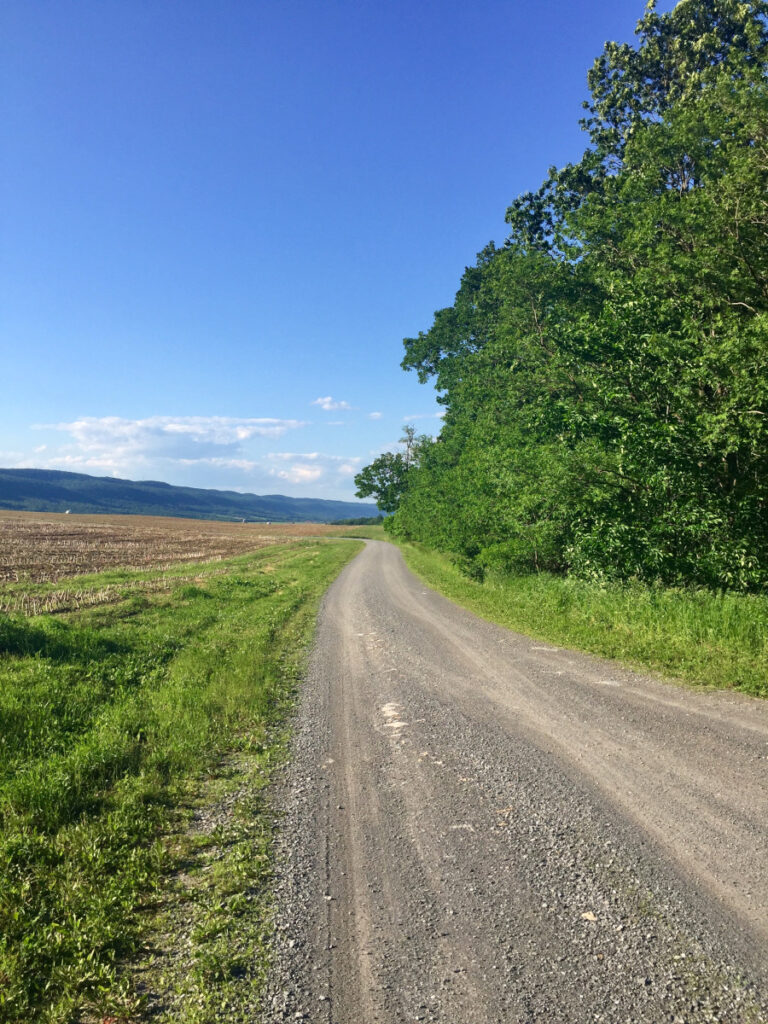
Beautiful Pensylvania… As much as I enjoyed living there, there were more music opportunities for me by traveling across the Atlantic to live in the Netherlands.

To say it’s been a complete culture shock is an understatement. While I could ramble ad nauseam about the minute details between these two countries, I would like to focus on one today: Transportation.

Like most of Europe, there has been an eco-friendly push to use public transit. No problem if you play the kazoo, but when you have an instrument larger than you, it can pose quite an “adventure.” This includes taking trams, subways, buses, and of course the topic of today: the train.

Honestly, I had no previous experience relying on trains to transport my instrument before I moved to Europe. When I was in youth orchestra, my parents would drive me an hour one way to rehearse in State College. Later, I would frequently go to Pittsburgh, a two-and-a-half hour commute, for private lessons. That is the norm, and it makes sense since 90% of households in the US have at least one car. The car represents flexibility and efficiency to travel wherever one needs to go. Realistically, it was the only option in the area I grew up.

Consequently, I had to quickly learn the dos and don’ts of traveling with my large and cumbersome companion when in Europe. Based on the short time I have been using European trains to travel, here’s what I recommend:

1. DO look for train cars with handicap, bicycle, or baby-stroller markings… engineers have designed them specifically for those items to fit. Your baby — ahem I mean bass will be most comfortable there.

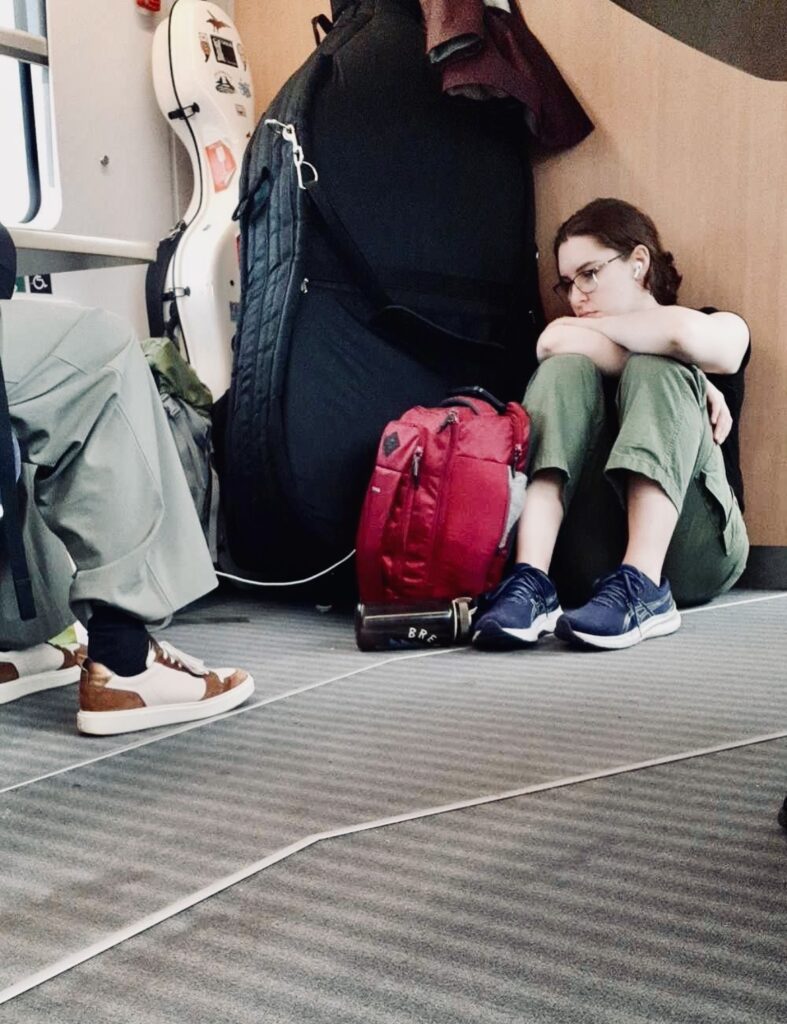
2. DO plan on getting dirty sitting on the floor, in the aisle, or wedged into a door frame. It’s not traveling in style, but it gets the job done.

3. DO pack snacks. No one wants to deal with a hungry and stressed musician.

4. DON’T expect to make every train. Even an Olympic sprinter couldn’t make it across the platform if the area is packed full of people.

5. DON’T forget to smile and be appreciative of the transportation staff. They’re just doing their job.

6. DON’T pick a fight with a drunk burly tattooed and pierced guy in Arnhem when he goes to sit on your bass!

Public transport

…sitting on the floor of a train… It’s not traveling in style, but it gets the job done.

As climatic as it would have been to tackle that man american-football-style to the ground, I quickly realized it was not worth it to try reasoning with a person who was drunk and twice my size. I simply offered him my seat, which he willingly took. While sitting on the floor was not the most comfortable position, I knew that my instrument was safe from him sitting on it. Did he learn his lesson? Probably not… (the real question that concerns me is what led him to being drunk at 10 am on a train!?)

The one positive aspect of this experience was knowing that I was being environmentally friendly by using public transportation. Furthermore, the project I was traveling for, the Theresia Orchestra, is part of a larger group called ICONS who works with an outside party to carbon-offset all the travel its musicians do. They have projects in four different countries and have already captured 74.44 tons of CO2. By choosing to take a train over a car, these emissions for each individual are more than halved. Additionally, consider that these trains can seat 450-900 people, compared to most cars only seating 5. For perspective, a single average car owner in America produces 4.6 tons of CO2 annually. While public transportation is not the most glamorous way to travel with a bass, I argue it is the sustainable thing to do for our planet.

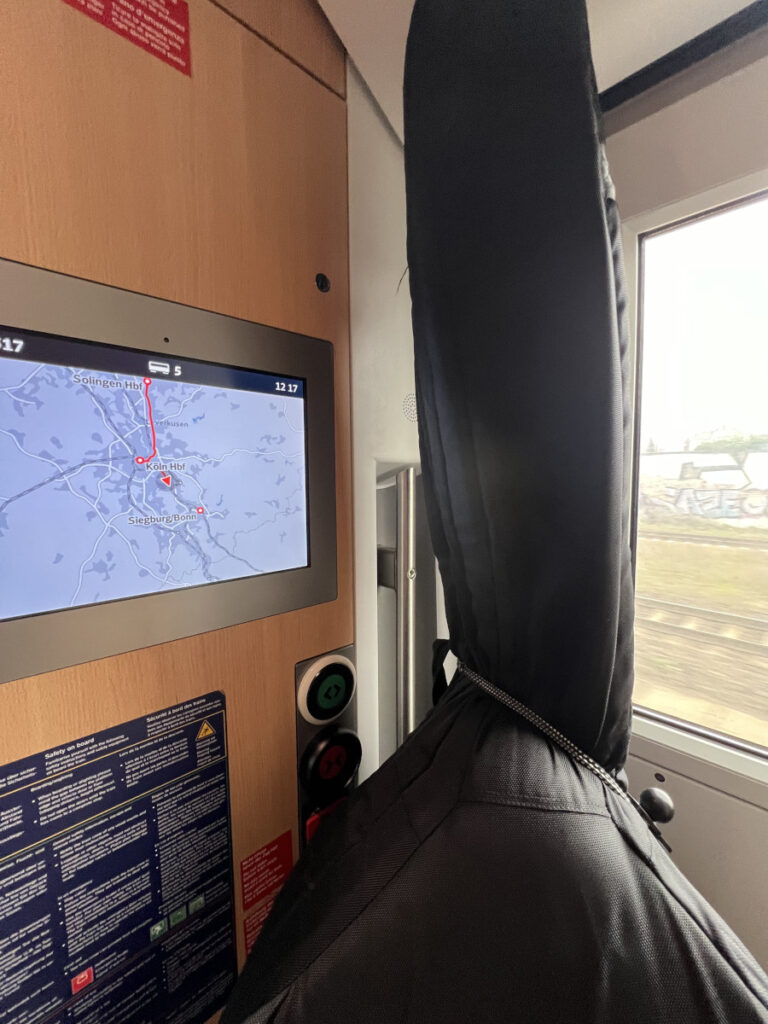
Bass by the door: at the very least, we will be the first to go down!

Hopefully these ramblings have been insightful and amusing. I’m curious to hear your instrument travel adventures.

Your hysterical-bassist* Ariel

*@hystericalbass is my instagram handle


Welcoming eight new string players

By theresia - January 30, 2024
Following auditions that took place on 19 & 20 January at the Conservatory of Boulogne-Billancourt in Paris, we are very pleased to welcome eight new string players in our midst.

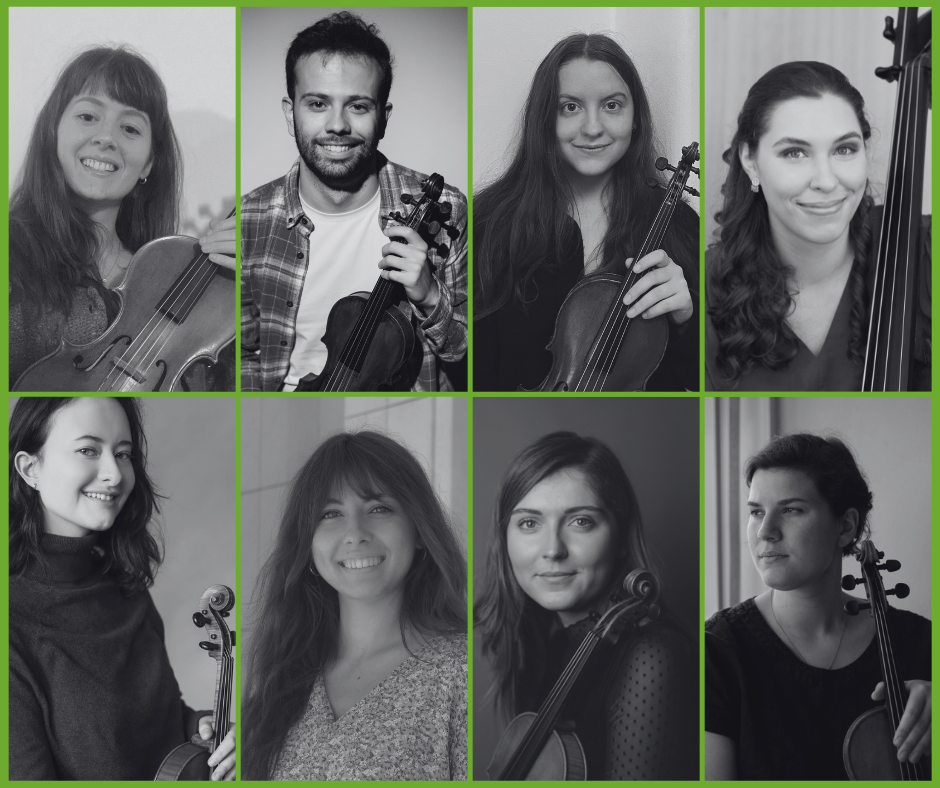
The talented string players that will be joining Theresia this year are: double bass player Ariel Walton (American), violist Clara de Benito Forriol (Spain), and violinists Maddalena Bortot (Italian), Anna Freer (Australian/Swiss), Lorenzo Molinetti (Italian), Anna Perl (German), Camille Poirier-Lachance (Canadian), Jenna Raggett (Irish).
Some of them will already participate in our first residency in March in Italy.

A special thanks to Giovanni Antonini and Gemma Longoni for joining the selection panel and guiding the jam session on Beethoven’s Fourth String Quartet in which all invited candidates participated.

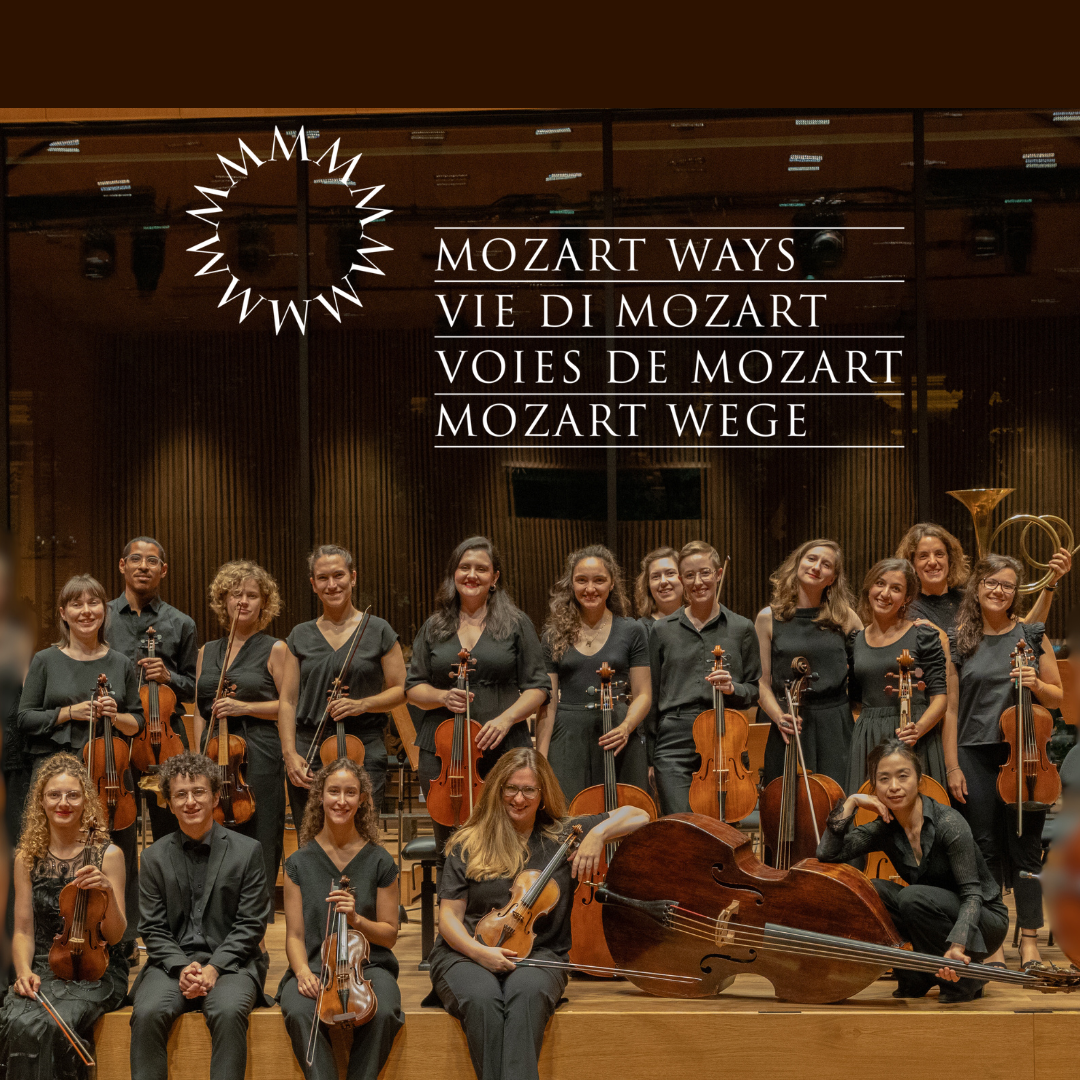
Theresia joins Mozart Ways

By theresia - January 23, 2024
All roads lead to Rome, they say. However, some lead to… Mozart.

Theresia Orchestra is now officially part of European Mozart Ways, a unique network connecting cities and cultural institutions linked to the timeless melodies of the great composer from Salzburg, known for his extensive travels across Europe. With this membership, Fondazione ICONS Innovation Strategies proudly positions Lodi on the Cultural Route certified by the Council of Europe.

A wave of beauty

By theresia - November 16, 2023
Cellist Matylda Adamus reflects on the experience of touring Haydn's 'Die Jahreszeiten' with Il Giardino Armonico and working with Giovanni Antonini as an apprentice.

Working on “Die Jahreszeiten” by Joseph Haydn with Il Giardino Armonico

by Matylda Adamus

The tour with Il Giardino Armonico was for me a very special experience and made me look at orchestral playing with completely new eyes, I have learned so much about the essence of precision, obedience, and sheer beauty. I’ll share with you the lessons and insights I gained during this musical adventure.

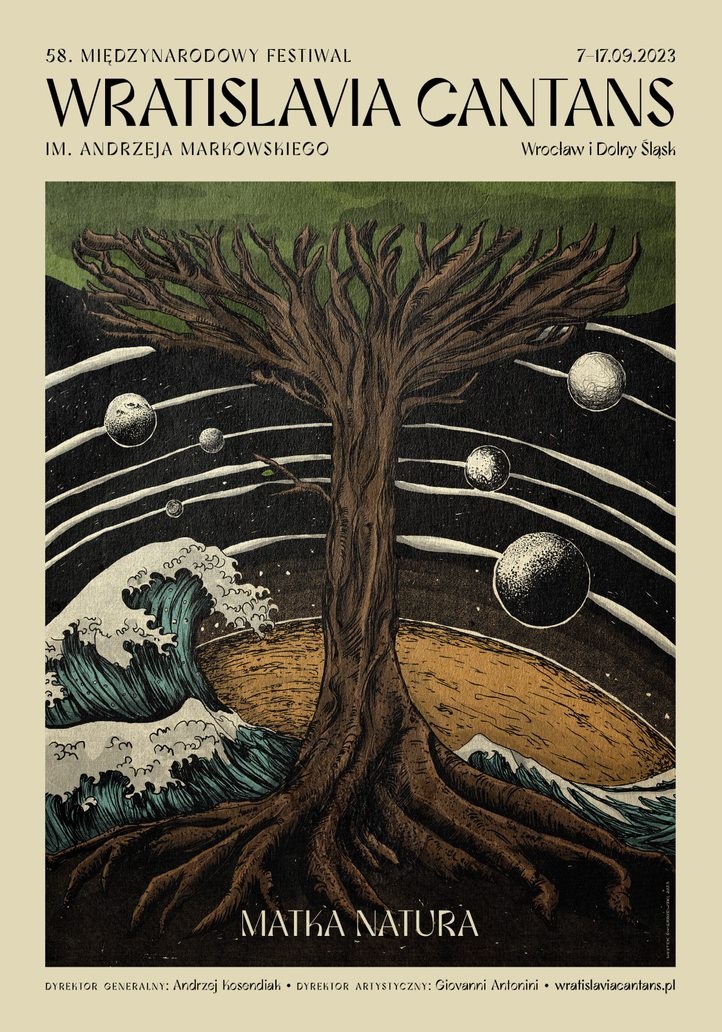
On 28th of August Il Giardino Armonico started rehearsing a secular oratorio ‘Die Jahreszeiten’ (The Seasons) by Joseph Haydn in the city of Wroclaw, my hometown. As the part of Theresia’s new apprentice scheme, Lucas Bernardo Da Silva, Guillermo Santonja Di Fonzo, Natascha Pichler and I joined the orchestra. After a first period of rehearsals at the National Forum of Music, we went on tour to Lucerne, Bonn, Bremen, Antwerp and Bucharest. We also performed in Wroclaw as part of the Wratislavia Cantans Festival.

Rehearsal period in Wroclaw 28.08-02.09

The initial three days of rehearsal with the orchestra took place without the singers and choir in the Red Hall of the National Forum of Music (NFM) – a modest rehearsal space smaller in size than the centre’s Main Hall but still with accommodating acoustics. From the very first chords, the orchestra sounded stunning, and I was very impressed. The sound of the group was solid and beautiful, the contrast between strings and wings was very well balanced, therefore, it was very clear from the very beginning what kind of sound I was expected to make – one that needed to be both warm and full, but also versatile and flexible.

Right from the start it was clear that working with Maestro Antonini would be an exercise in precision, detail and to the highest standards. His interpretation of The Seasons was amazing, very moving, and animated. I had to stay focused and diligent in every single phrase, bar and note. It was fascinating and a real challenge to contribute to the realisation of his interpretation, and I didn’t want to destroy the effect he was trying to create with any of my mistakes. It was very important to constantly keep my eye on the conductor, even in the most difficult passages. Thankfully, after a few days, I could remember my part better, which made it easier to glance above the score. At the end of the third day the soloists joined our rehearsals, and their singing had an astonishing effect. Almost each syllable seemed to shimmer like a perfectly polished pearl. At that moment, I felt an overwhelming sense of gratitude for being part of such a beautiful project – and there was still so much more to come!

From the next day, the ‘tutti’ rehearsals started in the Main Hall. The magnificent voices of the NFM Choir joined us and the grandeur of Haydn’s ‘Die Jahreszeiten’ was now palpable. I couldn’t wait for the concert tour to start. After several days of dedicated rehearsal in the Main Hall, I found myself completely immersed in this masterpiece. Working with Giovanni Antonini is characterised by such a high level of detail and precision, I couldn’t be happier with. Every movement and its phrasing acquired a distinct and vivid character in his interpretation. As the music itself was very descriptive, I appreciated Antonini’s explicit approach. This method required vigilance and excellent listening skills, which I found it to be very inspiring.

Our days were filled with colourful depictions – a swarm of fish, bees, and a flock of birds, all magically brought to life through the brushstrokes of music. One could hear a dog’s sniffing during a hunt, a bell ringing, the whirl of a spinning wheel, the sun rising, and people dancing, drinking, and celebrating. To be part of this ever-changing musical painting felt like a dream.

The absolute genius of Haydn is spectacular in this oratorio. Take the storm in the penultimate movement of ‘The Summer’ – aren’t the quick, slurred notes just sounding like a howling wind? And the soaring ‘sforzatos’ above them seem to transform into lightning bolts, maybe even resembling daggers that rip the heart open. It feels like Haydn surpasses the expressive boundaries of his time. On the other hand, the next movement seems almost ironically proper and elegant, reassuring the listener (and the player) with the message that the storm has passed and everything is alright again.

As Thomas May mentioned in the programme booklet for our concert in Lucerne “Summer, in contrast, presents a conflicted vision of nature as reflecting the deity’s majesty — the magnificent depiction of sunrise — and at the same time as full of dangers, a reminder of our fallen state: but the climactic thunderstorm, which anticipates so much of 19th-century program music, gives way to a fresh echo of Eden amid the simple pleasures of village life. More than clever “representation,” Haydn’s musical technique here generates its own structures of tension and release.”

I particularly enjoyed playing Autumn, especially the “Landvolk und Jäger” and the Finale. It was written with such charisma and the orchestra was playing with such energy, that it felt as if we had been transported from a concert hall to the heart of a forest. The amazing choral singing gave an additional touch of folk elements to the performance (e.g. with the ascending glissandos) – which was pure bliss to me. It was as if we had been spirited away to a lively peasant party in 1801, jumping and dancing with the aroma of a freshly caught boar stew in the air.

During the lunch breaks, we were usually having soup in the bar nearby the Music Forum. It was always a nice opportunity to chat with other musicians about their professional experiences. Stepping out of the bar, we spotted the posters of the Wratislavia Cantans festival hanging around the town. Their design was really interesting, and later we even saw them at the airport, when we begin to travel during the tour.

And then suddenly, rehearsal time was over.

On tour from 03.09 – 10.09 and 18.09 – 22.09

I really enjoyed all the concerts on this tour and one particular performance stood out for me. My favourite concert was in Lucerne where I really liked the acoustic of the concert hall with its many balconies, which gave the ensemble a special colour. The sound was incredibly crisp there. Every performance we gave during this tour was refined and always a bit different in each hall. The second concert was in Bonn, there for example, we played in a completely dark church where there were light projections on the walls. At some point it all turned into a depiction of pouring wine about which I couldn’t be happier, and it fitted the music perfectly as it was linked to ‘autumn’, the third part of the oratorio in which dancing peasants celebrate the wine harvest. The following concerts in Bremen and Wroclaw were also quite fulfilling. Sometimes, it was really easy to get tired because of constant travelling and moving around. It was not my first tour that lasted more than just few days, so I was trying to fight with the tiredness with my previous methods – sightseeing the cities and visiting art museums in the free time between the rehearsals. It works every time for me, and this time I remember particularly well the gallery in Bremen where works of Böcklin, Dürer, and Pisarro revived me before the following concert. At the later part of the tour we travelled to Antwerp and Bucharest. Visiting Romania was an exciting adventure, I have never been there I was absolutely captivated by the local architecture and welcoming society.

With each concert we gave I got more and more impressed by ‘Die Jahreszeiten’. Haydn used magnificent quotations from various pieces such as his own Symphony No.94 and from Mozart’s requiem. I also couldn’t help noticing that Beethoven used many elements for his symphonies that were similar to Haydn’s vocabulary in ‘Die Jahreszeiten’.

Looking back, I am very grateful I could participate in this apprentice experience. Grateful that I could play with the musicians I was always admiring and have been my idols for a long time. Thanks to this concert tour, I have now a better understanding of what performing at the highest level is like, how it sounds, and how great orchestral playing feels.

Early recordings: the past you don’t expect!

By theresia - May 26, 2023
Elia Bianucci, Theresia's clarinet player, takes us on a fascinating journey to discover early recordings

How was 18th and 19th century music performed 50 or 70 years ago? In this post clarinettist Elia Bianucci takes us into the fascinating world of early recordings.

Early recordings: the past you don’t expect!

by Elia Bianucci

It’s been a while since I first discovered early recordings, but I have listened compulsively to lots of them compulsively over the last period. And I must say that I kind of like them!

I am amazed at how many early recordings can be easily found on the internet, especially on YouTube and Spotify, and how much of a resource these can be for a musician interested in HIP. These recordings are such important documents from the recent past, from a time that we feel is close, musically speaking, but actually isn’t.

As musicians playing modern instruments, most of the time we find ourselves in a situation where traditions are involved: we happen to say or hear things like “traditionally this passage is played this way”, “it is a tradition to cut this part of the piece”, or “the singer traditionally makes this kind of variation at this point”. I reckon most people consider traditions to be an important part of cultural heritage, and we usually follow them without questioning too much. And I feel these people usually think these traditions were established a really long time ago, even a century or more. But by listening to the recordings, early ones and the less early ones, we can get a better picture and understand whether a tradition actually exists and when it started to exist. Nowadays we have a screen in front of our eyes, and at our ears, the drastic change that happened in the 20th century in the way of playing, singing and conducting.

Now, I don’t want to start talking about performing practices of the past inferred from listening to these recordings, first of all because I am not the right person for the job: I am not a musicologist, I haven’t taken any analytical courses on the subject, so I would be prone to make such simple mistakes that I’d be condemned never to open the case of my clarinet again if someone really involved in this field of research were to read this blog post. I just want to point out a bunch of people who made recordings I find interesting and extremely enjoyable to listen to.

The first is a conductor: Willem Mengelberg (1871-1951). I’ve listened to Beethoven’s third and sixth symphonies conducted by Mengelberg and I find them really cool.

Yes, they are not aligned to what we nowadays think was the performance practice at Beethoven’s time, in fact, these recordings are a bit post-romantic to my liking – as they should be since Mengelberg recorded in the first half of the 20th century! But who cares? I’m the first not to and you shouldn’t either! I like the way he plays with tempo to emphasise important passages or to create contrasts and how he manages to change the colour of the orchestra: and, this is even more astonishing when you think of the state of the recording technology back then.

The second and the third are singers: Fernando de Lucia (1860-1925) and Adelina Patti (1843-1919). They are two wonderful examples of how different singing styles can be and still create something truly beautiful. Adelina Patti catches me with her rubati and her portamenti. She might come across as a bit heavy at first, but after a few listens, I think she actually uses all these tools in the poshest way ever. Noteworthy is the change in the vocal register when she sings low notes: one can clearly hear thist in the recording of “Batti batti, oh bel Masetto” from Mozart’s “Don Giovanni” at the second 00:36-00:42. It always strikes me like lightning!

Fernando de Lucia is similar in his use of vibrato and rubato, and he is really wonderful at singing long notes with extreme diminuendos. I recommend everyone listen to the aria “E lucevan le stelle” from Puccini’s Tosca performed by Fernando de Lucia: I think this one is my favourite interpretation of the aria I’ve heard.

The last musician is a clarinet player: Charles Draper (1869-1952). I love how he plays, full stop. He has such a beautiful tone quality and uses tempo changes to the extreme but in such a refined way that when I discovered him, I immediately fell in love with him. I suggest listening to the recording of Brahms’ Clarinet Quintet for clarinet and string quartet, with Charles Draper at the clarinet and the Léner String Quartet. I must say that this is probably the best recording I have heard of this piece: and I say “probably” only because of my unconditional love for Sabine Meyer!

As a bonus, I leave another recording of Brahms’ Clarinet Quintet, again with Charles Draper on clarinet but this time with the London String Quartet. It’s an edited version, which means it is not the complete recording but only a few fragments linked together. The beginning in this case is even more breathtaking!

So this is the end, dear friends. Hopefully, you found this blog post interesting enough: I hope you will also dare to try and listen to some of the above suggested recordings! I’m sure you won’t be disappointed!

Theresia Orchestra – A year in review

By theresia - December 29, 2019
This is the time of the year when each of us looks back and considers what happened in the previous twelve month: was that a good year? Did something exciting happen? Or were they boring and unsuccessful? Here in Theresia we can proudly answer that our 2019 has been awesome!

This is the time of the year when each of us looks back and considers what happened in the previous twelve month: was that a good year? Did something exciting happen? Or were they boring and unsuccessful? Here in Theresia we can proudly answer that our 2019 has been awesome!

(more…)