Discovering EMPOWER

By Emilia Campagna - June 16, 2022
Let's get into the heart of EMPOWER and discover the five different skills that we want our musicians to improve

How do you empower a musician? Traditionally, masterclasses and workshops are the places where young talented musicians improve their technique, deepen their knowledge of the repertoire, and challenge themselves in playing in front of an audience and with colleagues. Music, though, is not a musician’s entire life, not even when you think only of their work life. One has to manage the business side of the whole thing, take care of one’s physical health, and even promote oneself. That’s a lot.

We kept this kind of complexity in mind when we found ourselves planning the training modules of the capacity-building activity, a program at the very core of the European funded project EMPOWER. We defined five different competences that we want our musicians to improve: artistic performance, naturally, but also organisational, economic and managerial skills; digital and technological skills for marketing and communication; personal development and well-being; ecological transition.

As Silvia Raimondi, project manager at ICONS pointed out, we aim to “give young musicians the skills to manage themselves by the means of business management, communication, by coping with stress and also by acting sustainably”.

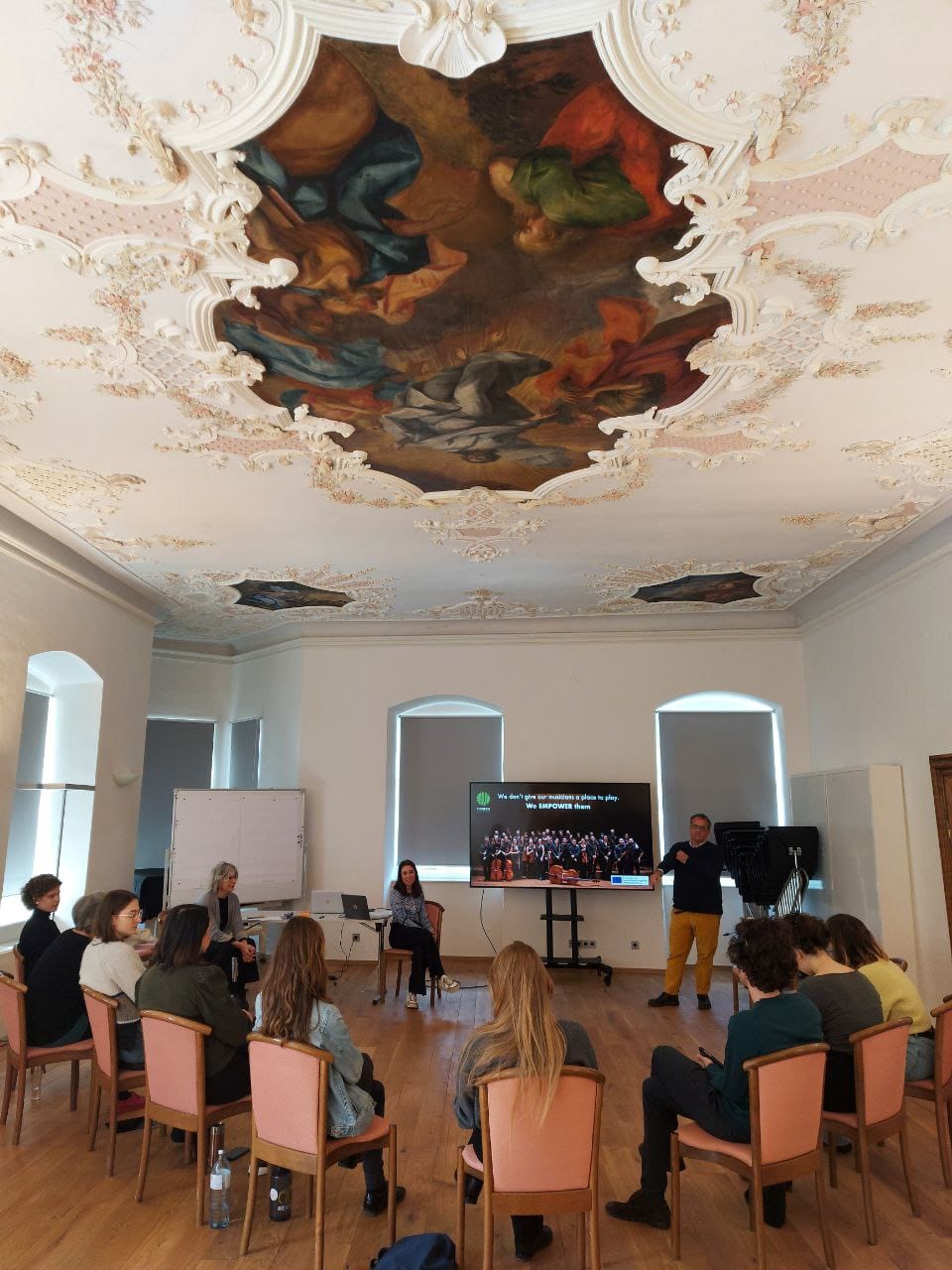
Eleven seminars are planned to cover all five areas: the seminars are going to be held mainly online and initially they will be intended for Theresia musicians only, but the plan is to expand our audience in the future including Theresia’s alumni and Theresia’s partners that may be interested. 

In this first phase of the project, the formative offer will be tailored according to the specific need of every musician, through a preliminary interview that will state the needs; the plan will be then adjourned every six months.

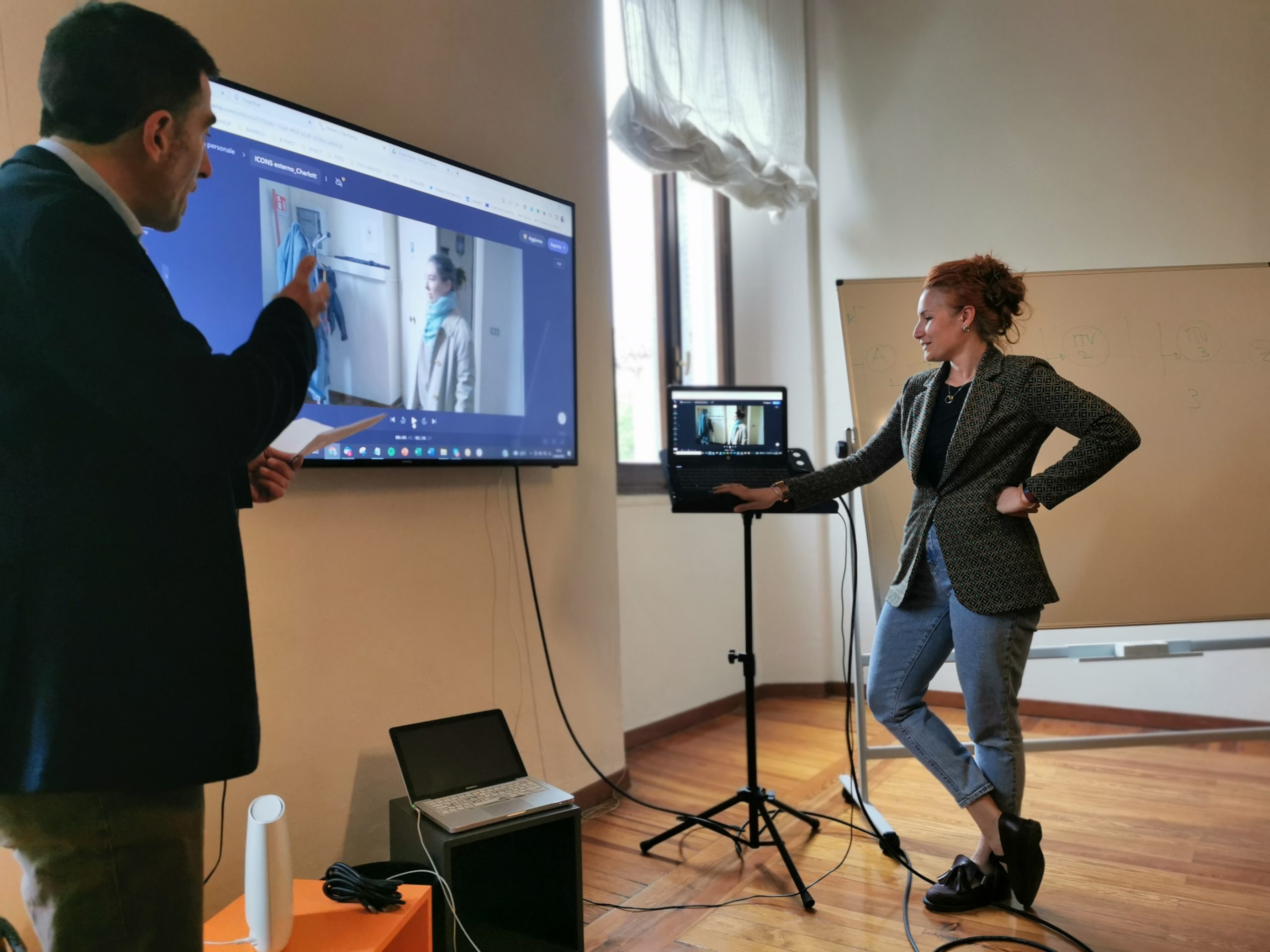
Teachers involved are Simone Laghi, Artistic Secretary of Theresia Orchestra, who will discuss specific aspects of organology of the classical period, providing information about the development of the Orchestra as a musical entity during the period between 1750 and 1800; conductor Vanni Moretto, who will provide musicians with the tools to understand and interpret eighteenth-century music, through the precious information provided by 18th century’s essayists; musicologist Bertil Van Boer, Professor Emeritus of Musicology-Theory at Western Washington University, who will deepen the general historical context and the question research of sources and references in archives. Looking at the managerial side of a musician’s life, Claudia Crippa, Senior business analyst at ICONS, will hold a two-part seminar focused firstly on improving knowledge about the musical “sector” and their economics, the way economics impact a musician’s career and secondly to improving knowledge about self-resources to cope with the “market”. Charlotte Michi, Director of the Innovation Farm Unit and Project Manager at ICONS will help musicians to strengthen personal digital communication skills, by giving an overview of the different online channels and providing musicians with the basic digital skills to promote their work on them. A second seminar will focus on the creation of content to be shared online. Soprano and performer Laura Catrani will guide musicians to experiment with the beneficial effects of postural techniques and GYROKINESIS® specifically designed for musicians. Speaking of well-being, Alessandra Calzarossa, professional coach and senior HR expert, will address the area of the “inner game” and emotional impact on performance and results to improve the musician’s performance and professionalism. Last but not least, Veronica Meneghello, Project coordinator for national and international projects on sustainability in ICONS, will help musicians to understand how to improve their knowledge of the environmental impact of their lifestyle choices, especially those connected to their work and travels, and thus lower it. 

The series of seminars will start during the next residency and will be focused on well-being through the practice of postural techniques and GYROKINESIS®. Stay tuned to read further details on both the residency and the seminar on our blog!

Download our catalogue and find more about the capacity building program

Meet Theresia: Jonathan van der Beek

By Emilia Campagna - May 31, 2022
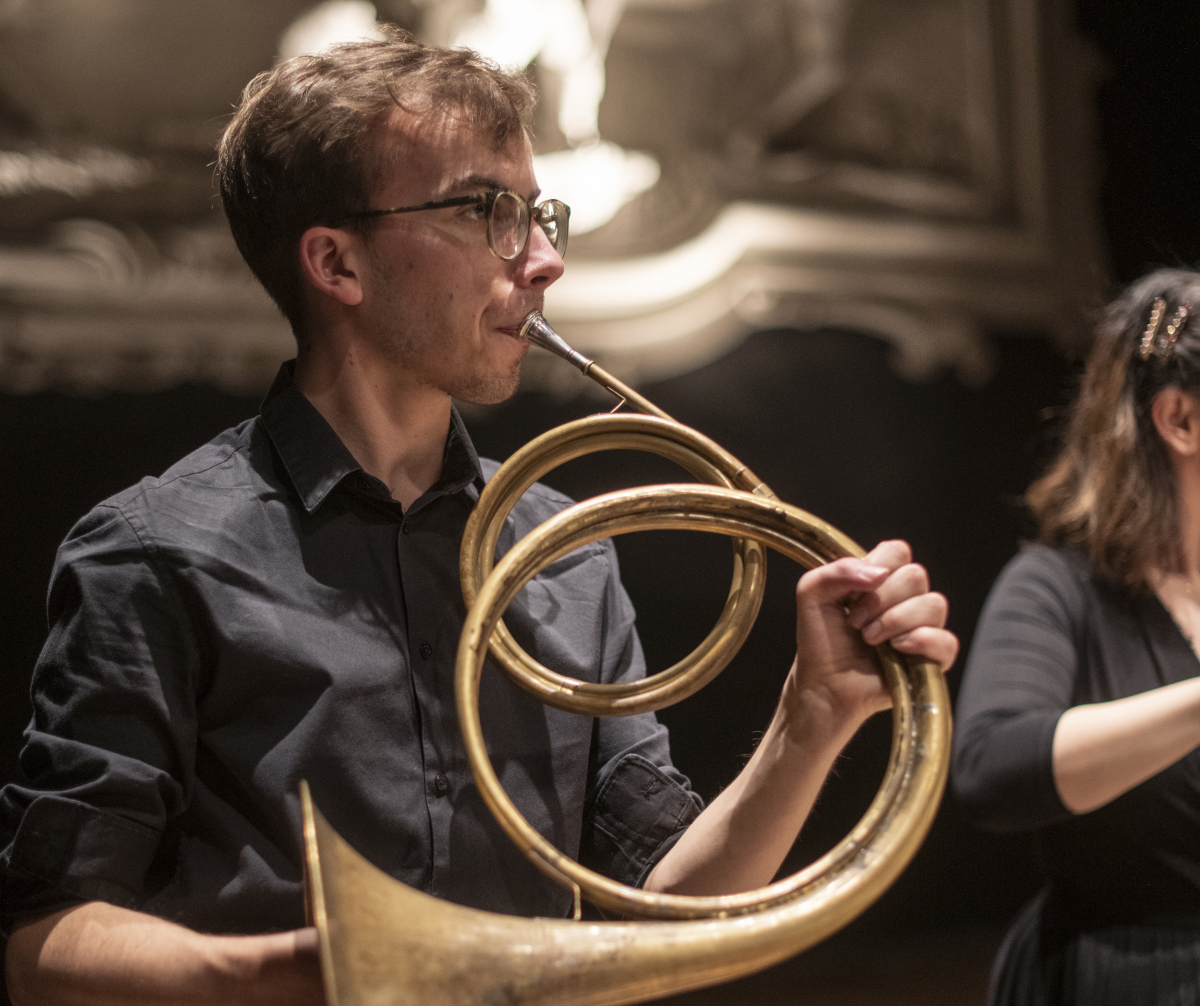
Does every musician remember how they fell in love with their instrument? Belgian horn player Jonathan van der Beek does: find more in the new interview of the Meet Theresia series.

Jonathan van der Beek, Belgian horn player, joined Theresia in 2021: let’s find something about his passion for music, his experience and his expectations.

Tell us something about your musical story: how did you start playing and when and why did you decide to focus on the historical instrument?

I wanted to play the horn from a very young age on – I think that happened when I was four years old. My parents had this CD from Peter and the Wolf (Prokofiev) where the horns represent the wolves. I fell in love with the warm sound of the horn and when I was old enough, I immediately started in the music school. My first teacher in music school, who would be my horn professor in the Conservatory later on, was a horn player but also a phenomenal natural horn player. I listened a lot to his CD’s where he plays the natural horn, and that’s why I have always been interested in it. I started studying the modern horn but when the Coronavirus crisis left us all without any goals I decided to enrol for an audition and start practising the natural horn. Furthermore, I fell in love with the instrument and its sound. Some months later I played my first projects on natural horn, and nowadays I am very happily combining modern horn with the natural one.

How did you know about Theresia?

The first project I ever played on natural horn I played together with Rodrigo Lopez Paz who told me about Theresia. I went to search for Theresia on the internet, and it seemed like an opportunity I didn’t want to miss. So, I signed up for the audition.

You auditioned for Theresia in the summer of 2021: how was it, and which pieces of advice could you give to some colleagues of yours who may take part in the next auditions?

The only advice I can give is that you should really go there! Normally, an audition is a quite frightening and sometimes disappointing experience. In the case of the Theresia audition, this was exactly the opposite. It is called an audition because they are making a selection in the end, but it felt more like a workshop or even a masterclass in a beautiful environment. We got to prepare certain pieces, and we had to ‘rehearse’ in front of a jury the whole day. This made me very comfortable as I wasn’t judged only on the 5 first minutes of playing. When I went out of the audition, I was just so grateful that I got the opportunity to work with Alfredo Bernardini and all the great musicians that participated. If I were not selected, I would still take this great experience home.

You took part in the latest project, a wind academy with tutor Alfredo Bernardini. How was it? What did you like more about this experience?

I had a great time at the wind academy, especially because the group of musicians and friends we played with was so close. We had a lot of fun playing the music, but also outside the rehearsals. I like very much that we got the opportunity to play 4 concerts in 4 different cities. It was exciting to have to deal with another acoustic every time.

You worked with Maestro Bernardini both in an orchestral and in a chamber music project: which was the difference between the two experiences?

Both times were unforgettable experiences, but there was a clear difference; Alfredo was really the conductor in the orchestra project, while he was more like a coach in the wind project. I really like his way of working and experimenting with the group of musicians he works with. This was similar during both projects.

During the residency, you were presented with the EMPOWER project, an initiative funded by the EU: what do you expect from it? How do you think working with Theresia can “empower” you?

Foremost, I want to say that Theresia already empowered me in developing my skills as an instrumentalist. About the particular EMPOWER project: I am looking forward to gaining more knowledge in the domain of historical informed performance, and I am also interested in the more ‘economical’ subjects of the course. I think this combination of residencies with the orchestra, chamber music projects and specific courses in domains where I am very much interested in, will empower me the next years as a musician, thanks to Theresia Orchestra.


New auditions coming soon!

By Emilia Campagna - May 20, 2022
Theresia is looking for talented musicians: don't miss the chance of the next auditions!

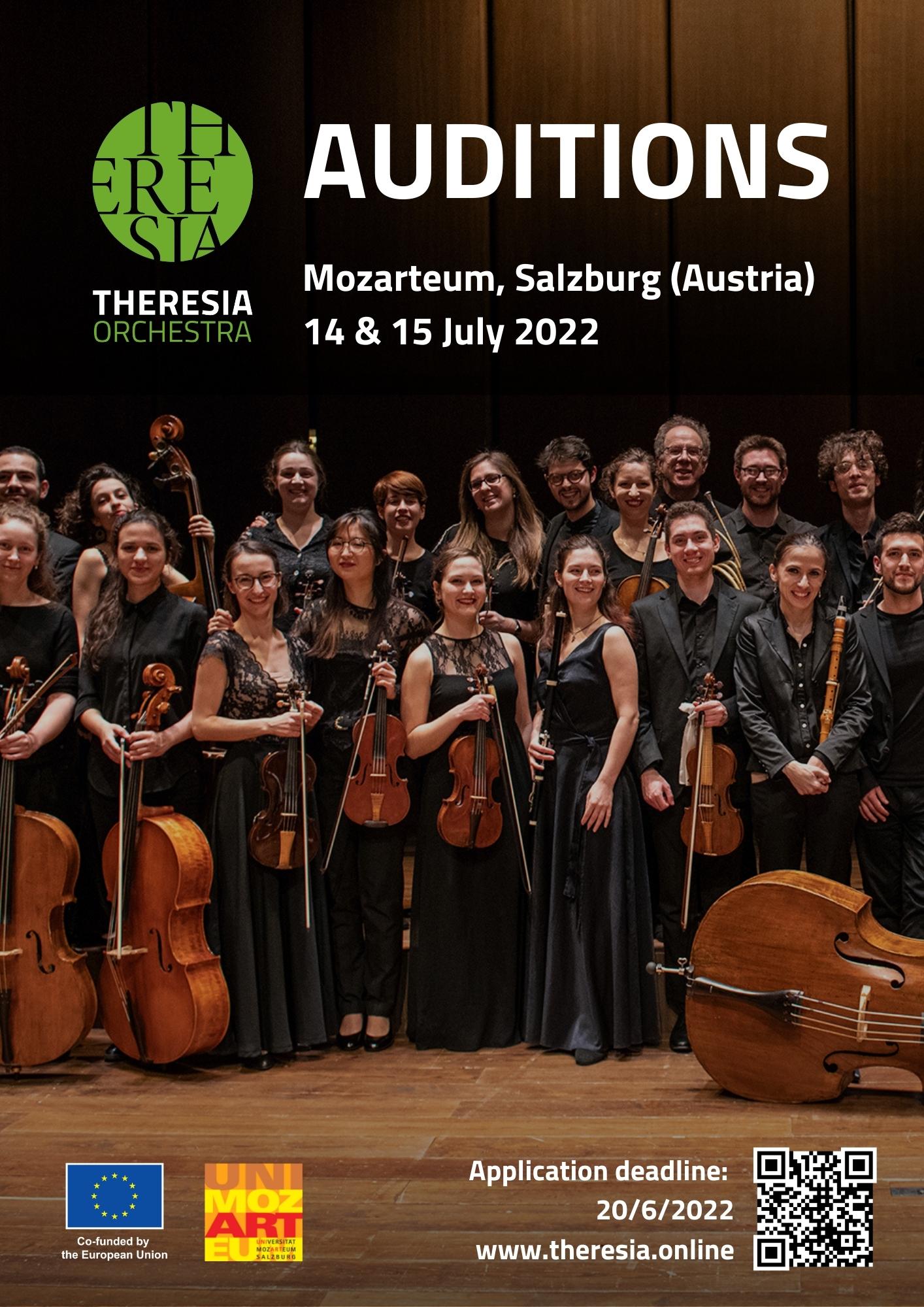
Good news for young talented musicians: a contest based on merit was launched to award Learning Grants to musicians wishing to enter Theresia Orchestra and participate in its learning activities for the period August 2022 – November 2023! Meaning, auditions are to be held soon.

Instruments involved are violin, viola, cello, double bass, flute, oboe, clarinet, bassoon and horn. Auditions, during which candidates will be asked not only to play but also to express their motivations to participate in the project, will be held at Schloss Frohnburg in Salzburg (Austria) thanks to the collaboration with Salzburg Mozarteum, on 14 July 2022 for wind instruments and on 15 July 2022 for string instruments, and will be run as chamber music workshops under the supervision of the Board of Examiners. Components of the Board of Examiner will be Alfredo Bernardini, Theresia’s Principal Conductor, violinist Gemma Longoni (Concertmaster), Artistic Director Mario Martinoli, Charlotte Michi (Fondazione ICONS Director), and Elena Gaboardi (Fondazione ICONS Board Member).

Selected musicians will participate in five of the residencies from August 2022 to November 2023: the first two of them, both in August, will be chamber music residencies, for string players in Geneva (Switzerland) and wind instruments in Totana (Spain). An opera production is also scheduled: residency n. 36 is devoted to Cimarosa’s opera “Le astuzie femminili”, with concerts in Rieti and Rome in October. Orchestral residencies will follow, with projects in which Theresia Orchestra will be conducted by Alfredo Bernardini, Alessandro De Marchi and Giovanni Antonini. Check the website for more info and updates!

Joining Theresia is a great opportunity: in addition to being involved in such musical projects, the musicians who will be particularly distinguished by artistic merit at the end of their granting period may have the possibility to extend their grant for one more year and may be invited to join the professional alumni orchestra named Concerto Theresia. Moreover, musicians will be involved in the activities made possible by the European project Empower: some of them will be “ambassadors” at the very centre of a program (Ambassador Program and Audience Development), which aims to engage new audiences in part thanks to some of our musicians acting as testimonials.Still, Empower will affect all musicians involved in Theresia, thanks to its learning program and capacity building modules..

Of course, not everybody can participate, and some requirements are mandatory: applicants must be born after (or on) 1 January 1994 and must be citizens of one of the Countries of the European Union or the European Economic Area. Non-EU citizens may apply if they have a residence permit for study in one of the Countries of the European Union. They must have in-depth knowledge of performance praxis on authentic instruments and of the use of period instruments. Last but not least, the use of the classical bow for strings and classical instruments for winds is mandatory during the Auditions.

Download the full regulation here and don’t forget to spread the news!

Theresia Wind Academy

By Emilia Campagna - May 3, 2022
Next concerts of Theresia wind ensemble remind us the importance of playing chamber music

What is that makes special an orchestra like Theresia and defines it as a true classical orchestra? Two things, in fact: playing according to the historical informed performance principles, and playing the classical repertoire, i.e. music composed between 1750 and 1815. These two boxes we can definitely tick, and speaking of repertoire, we are never tired of exploring it, always deepening our knowledge and awareness of the incredible richness of classical music.

And actually, there is a third one: performing chamber music. Aside from being a powerful opportunity to improve technical aspects and widen the repertoire, chamber training facilitates mutual musical knowledge among ensemble members, with benefits for the quality of the work of the entire orchestra.

Our wind ensemble for example is at the centre of a chamber music residency twice a year. This is the case of the next project, which will take place from 2nd to 9th May in Lodi, with concerts in Lodi, Trieste, Capodistria, Turin.

The musical program is usually devoted to wind chamber music of the Viennese style, and so it is this time. Under the guidance of oboist Alfredo Bernardini, eight selected members of the orchestra will rehearse and perform music by Mozart, Beethoven and Krommer.

Franz Krommer was one of the most long-lived composers of the classical era: his 72-year lifespan began in 1759, half a year after the death of George Frideric Handel, and ended in 1831, nearly four years after that of Ludwig van Beethoven. His output was prolific, with at least three hundred published compositions, including much sonorous, idiomatic and at times powerful music for wind ensemble, for which he is best known today. Theresia wind ensemble will perform his Partita in B-flat major.

As for Mozart, we looked for something not obvious: our wind ensemble will perform an arrangement by Johann Nepomuk Wendt of Die Entführung aus dem Serail. The selection includes seven highlights of the opera, starting with the Ouverture.

The musical program will end with Beethoven’s E-flat major Octet, op. 103: it was composed in 1792 in Bonn, intended for Prince-Elector Maximilian Franz’s excellent Tafelmusik ensemble. Beethoven was so satisfied with his own musical invention that three years later he transcribed it for string quintet. The Octet itself remained unpublished until the death of the composer.

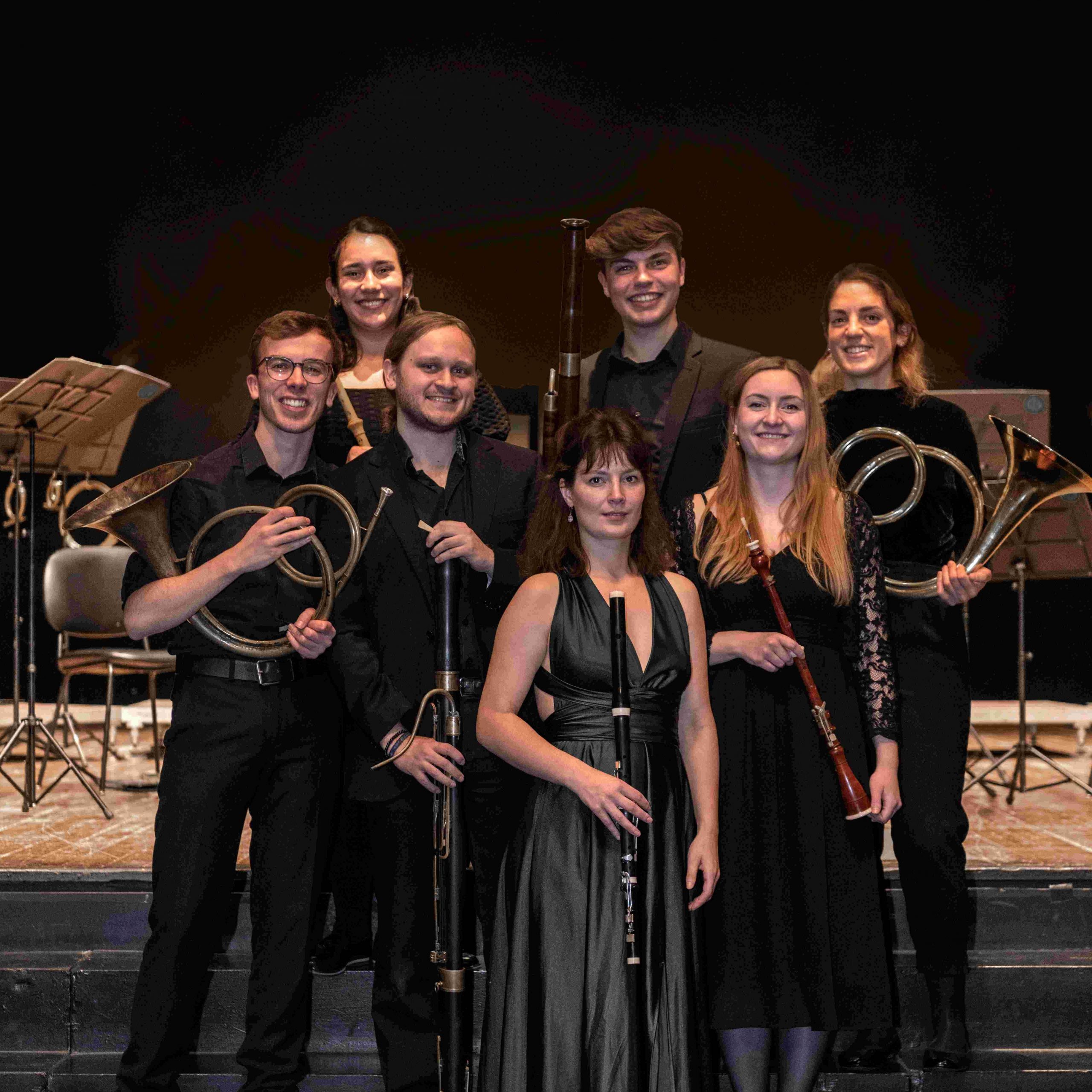
Musicians involved in this new project are Laura Hoeven (Austria) and Paulina Gómez Ortega (Colombia) – oboe; Claudia Pallaver (Italy) and Jonathan Van der Beek (Belgium) – horn; Luís Tasso Athayde Santos (Australia) and Angel Alvarez (Cuba) – bassoon; Franziska Hoffmann (Germany) and Simon Pibal (Austria) – clarinet.

Fondazione Cariplo contributed to this residency as part of the project “Alla scoperta degli strumenti a fiato dell’Orchestra Theresia” (“Discovering the wind instruments of Theresia Orchestra”).

Meet Theresia: Paulina Gòmez

By Emilia Campagna - April 26, 2022
Paulina Gòmez flew from Colombia to Germany to study oboe. She is one of the new members of Theresia Orchestra and we asked her to tell us more about her story.

Paulina Gòmez flew from Colombia to Germany to study the oboe. She is one of the new members of Theresia Orchestra, and we asked her to tell us more about her story.

Paulina, how did you start to play the oboe? Was it your idea, or did someone from your family or school suggest it?

I started studying music because my dream was to become a singer, so I was having music classes, and I was singing with the school choir. One day, we played something with the school orchestra, I can not remember what, and there was this instrument I didn’t know existed. I thought it was incredible, and the sound just enchanted me.

That day I went back home and started doing some research. That is when I discovered the oboe. I remember I started reading a lot about the instrument, and about double reeds. I also looked for some videos on YouTube, the first concerto I heard was Mozart’s oboe concerto. That’s how I decided to play the oboe!

In retrospect, I was really lucky. Even though my parents did not know the instrument, they have always supported me and my decisions. Thanks to that, I was able to start my path in this beautiful profession.

Why did you decide to move to Germany?

Since I started studying music, coming to Germany was one of my main goals. I even started learning German when I was in Colombia. I have always thought Germany is a country with a great music scene, great schools, and fantastic teachers. So I always dreamed of coming to study in Germany, and it has been a challenging road, but here I am.

Was it hard to move to Germany from Colombia? What do you miss more about your country?

The change from Colombia to Germany was very complicated, not only because of the language and cultural differences but also learning to live alone away from my family and friends. Now I have been in Germany for a little more than five years, and I consider it my home. I have met new people, who have become my family away from home. Besides, now I’m used to the way of doing things in Germany, the rhythm of life, even if it is very different from Colombia. I believe Germany has given me the opportunity to grow in many ways. Obviously, I am always happy to go back to Colombia and spend some time there, I think what I miss the most is obviously my family, and then the Colombian food, which has an incredible diversity that is very difficult to find in Europe. 

Was it in Germany that you first met period instruments? Tell us why you decided to switch to it from modern oboe.

Actually, my first encounter with the baroque oboe was in 2015 when I was at an oboe festival in Argentina. One of the invited teachers was Diego Nadra, with whom I had the opportunity to play the baroque oboe for a few minutes: well, from there I had the idea of historical instruments, but unfortunately, it is not something that can be studied in Colombia.

I came to Würzburg in 2017 and during my master’s in modern oboe, I met my current teacher, Clara Blessing, who taught me the world of historical instruments. With her, I had the opportunity to start learning historical oboes, and I simply fell in love with these instruments. I love their sound, the feeling you get when you play a historical oboe, and the flexibility that they give.

Was the change challenging? How much is more difficult (or easier?) playing a historical oboe?

Well the change for me was quite big: although they are oboes, played with a double reed, they are completely different instruments. Technically it was interesting to get used to having a completely different instrument in your hands. Still, the basics are the same and this made a lot of things easier. Adapting to building reeds for other oboes was also difficult at the beginning, also because I didn’t have my own instrument but one that I had borrowed from the university. But historical instruments are much more than just playing them, well at least for me: they involve new ways of working with historical sources, looking for manuscripts, and reading books like the ones by Quantz and CPE Bach. This is also an important part of this world that I deeply love.

How did you know about Theresia and when did you join it?

I found out about Theresia through social media. When I saw that they had auditions I thought about applying, at the time I had very little experience with classical instruments. My teacher Clara also suggested it to me, underlining what a great opportunity it was. So I went for it and applied to the audition.

Back then I was reading about the orchestra and listening to their work and I was incredibly excited about being part of this. For me, being part of Theresia is an almost unique opportunity since there are very few options for us as historical instrumentalists to gain professional experience.

So far I have only participated in one project with Theresia, but I hope many more will come!

How is the classical music scene in your country? Is music taught in schools?

The music scene in Colombia is not so big, there are of course orchestras and festivals. The historical instrument scene is just beginning, there are some people working with this in Colombia, but is a process that needs time.

In Colombia, music is taught in primary and middle schools. There are university and government programs in some cities where people can approach music, but for me, these still have a lot to grow.

Where do you see yourself in ten years?

Something I learned during this pandemic is that making long-term plans is difficult because sometimes life surprises us all. In a few years, I would love to continue making music and continue taking my music to different parts of the world. I would also like to give back to Colombia and go teach the next generation of musicians. I have always thought that it would be very good to make the way for future generations easier. For example, for them to have the opportunity to know the world of historical instruments at an early age.

Empower, we are ready to go!

By Emilia Campagna - March 31, 2022
The chamber music residency in Ossiach wasn’t only the chance to study and perform wonderful music under the guidance of Chiara Banchini: during the five-day stay, our musicians were told about the new important European project involving Theresia, EMPOWER.

The chamber music residency in Ossiach wasn’t only the chance to study and perform wonderful music under the guidance of Chiara Banchini: during the five-day stay, our musicians were told about the new important European project involving Theresia, EMPOWER.

As we have announced recently, a 3-years grant has been awarded to Theresia Orchestra by the Creative Europe Programme to develop excellence in orchestral learning and soft skills acquisition by our young artistic talents. Thanks to this achievement, Theresia Orchestra has entered into the group of the leading European youth orchestras, together with EUYO – The European Union Youth Orchestra and other few acknowledged ensembles. 

The Chamber Music Residency in Ossiach was the first initiative developed within EMPOWER, involving a selected group of string players. As you know, they studied and performed string quartets by Haydn, Mozart, and Boccherini with a final concert at Kultur Forum Amthof

During the residency, we scheduled a meeting to explain the project to the people who will be the most involved onesour musicians. We especially focused on one of the branches of activity, the Ambassador Program and Audience Development, which aims to engage new audiences in part thanks to some of our musicians acting as testimonials (Ambassadors). As Charlotte Michi, Project Manager of Empower, explained to us, “Empower is strongly devoted to promoting engagement, so we didn’t want to explain the whole thing giving our musicians a traditional speech. After a brief introduction, we started a role game to find out together which may be the characteristics both of an Ambassador and of a new member of the audience.” 

Theresians were enthusiasts, and together they pictured the ideal ambassador and the possible new member of the audience: “Words that came up frequently to describe the ambassador were open-minded and emphatic (meaning able to listen to others and not just to teach). Regarding the audience, foremost they should be young, as people over 50 are already part of their audience, a thing that can be seen in concert halls and YouTube demographics. They should be interested in music, but preferably in other genres. One of the musicians stated that it is easier to approach someone who is interested in jazz, for example, instead of someone who already listens to classical music.” The problem of how to expand the audience seemed very important to our musicians: “Some noted that Sometimes it is easier to bring music to the people instead of expecting people to go there. They pointed out that it would be interesting to play in “unusual” locations, because classical musicians usually play in beautiful places, but it is difficult to reach new audiences there”.

Young musicians are especially keen on using social media to promote themselves and their activity, and Tommaso Toni offered to narrate the experience of Ossiach through a “take over” on his Instagram channel: you can find it here.

The project was so welcomed that we had three self-candidatures for being ambassador. The next step will be a workshop in Lodi to train them and plan their first actions. We are looking forward to it!

The importance of playing in a quartet

By Emilia Campagna - March 19, 2022
Chiara Banchini, tutor in the Ossiach residency, talks about playing in a quartet and how no string player should miss it

A chamber music residency is taking place during these days in Ossiach, a beautiful place we recently wrote about. A selected group of string players (Tommaso Toni, Aura Fazio, Léna Ruisz, Lavinia Soncini, Anna Krzyżak, Irina Fârtat, Cecilia Clò, Leah Plave) is rehearsing under the guidance of Chiara Banchini, violinist and conductor with whom Theresia has a strong connection.

The musical program is devoted to string quartets by Haydn (String Quartet in d minor op. 42 Hob. III:43), Mozart (String Quartet in d minor n. 13 KV 173) and Boccherini (Quartets G 200 and G 223 “La Tiranna”). A concert at Kultur Forum Amthof will close the residency.

Ms Chiara Banchini, this chamber project is devoted to string quartets: what are our musicians playing and how is the residency going?

It is going very well. A couple of participants couldn’t be there, unfortunately, as they were quarantined the day before the beginning, so we had to slightly resize the program. Still, it remained faithful to the initial idea of combining an “important” quartet (by Haydn, Mozart or Pleyel) with one of the short quartets of Boccherini, which are real jewels. They are very agile pieces of music, with only two movements but perfect to make the experience of playing in a quartet.

Many of the musicians present at this residency are new members of Theresia, selected in the auditions last summer: how is the work going?

I am extremely pleased with the level of all the participants: I can see they are very prepared, well-tuned, and they are also very good at working together and listening to each other. I think the general level of the orchestra has risen a lot in the past five years. Everybody is doing a great job.

How significant is it for a string player to live the experience of playing in a quartet? And how difficult is it?

As a matter of fact, it is both important and difficult! A string musician has to face huge problems in terms of tuning and sound. It’s way easier to play in another kind of ensemble, like a piano trio or a piano quartet, or playing together with wind instruments. A piano provides you with a constant reference for the tuning of the ensemble, although you are forced in sticking to equal temperament, which is not ideal for us string players. With wind instruments, the differences in sound make things easier in terms of tuning and blending. Then, you have relational issues to face: many famous quartets are known also for their members’ quarrelsomeness! But, the repertoire is so stunning, and rich: even only focusing on Haydn, you have more than eighty wonderful quartets! From every point of view, playing in a quartet is something no string player should miss.

In your professional activity, how much did you dedicate to string quartets?

A lot. With my musical partners from Ensemble 415, we explored Haydn, Mozart, Boccherini, Beethoven’s opus 18. We didn’t go further, though. My generation was the first to switch from the modern instrument to period one: deepening the baroque style, moving one toward the classical repertoire, studying period essays and looking for sources was a big deal. When I think of going beyond Beethoven and approaching, for example, Schubert, I feel quite overwhelmed with the idea of studying and knowing everything I can. For this generation, things are different: they are more confident because they could take advantage of the expertise and the achievements of the older ones, and they have had more chances to experiment playing on period instruments, so I’m sure they would easily approach composers like Schubert. In this “easiness”, though, I also see a lack of interest in studying methods and deepening their theoretical knowledge of historical performance, so with a bit of more effort they will really go a long way.

Our places: Ossiach

By Emilia Campagna - February 21, 2022
There’s a place in the heart of the Alps that from time to time becomes our house. Read the article to find more about Ossiach and the Carinthian Music Academy (CMA)

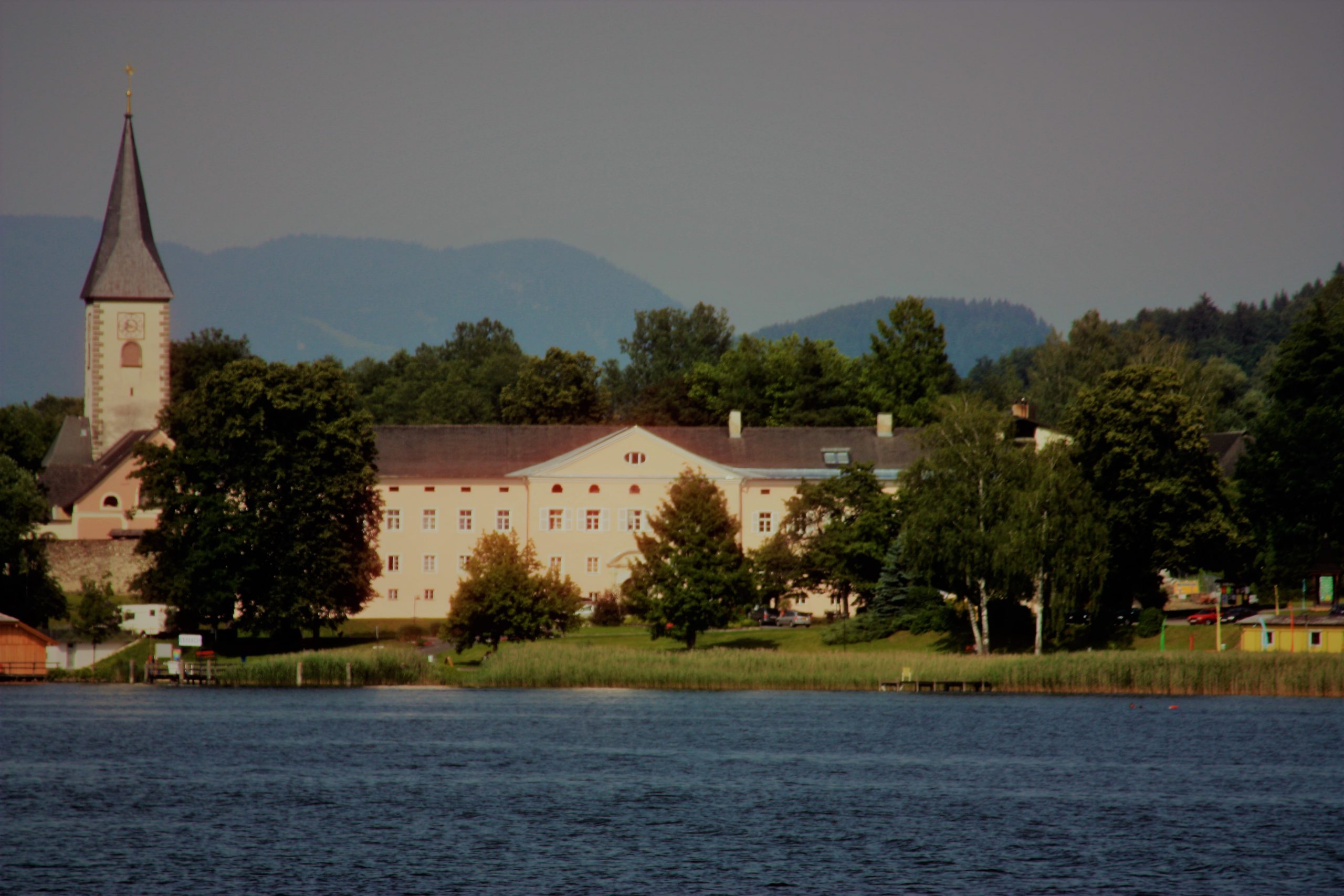
There’s a place in the heart of the Alps that from time to time becomes our house. It’s a magical place, devoted to music, thanks to the Carinthian Music Academy (CMA) which has so far been our partner in two projects we held there. The name of the place is Ossiach, a little village in the South of Austria, famous for the historic Ossiach Abbey, with its Baroque collegiate church. Today the former 11th-century Benedictine monastery is a renowned cultural centre, beeing the venue of the Carinthian Summer international music festival and the Carinthian Music Academy.

Talking about CMA, it was founded in 2009 with the mission, as chief of administration Ulrike Baumgartner told us, of being a competence centre for further education and training. The CMA has quickly established itself as a popular meeting place for music and culture enthusiasts of all genres. Besides the regular course program, the CMA also offers the perfect infrastructure for events at two locations: Ossiach Abbey at Lake Ossiach and the Music Center Knappenberg high up above (second location, about an hour away from Ossiach, founded in 2007)”. The activity of the centre is intense, as it “organizes itself the concert series and supports organizers in conducting their concerts. Around 150 concerts and competitions take place annually”. It hosts “mainly Austrian musicians. But also musicians from all over Europe and American universities visit the CMA for rehearsals.” As everywhere, Covid affected CMA activity: “In 2020 and 2021, the academy had to stay closed for several months. Of course, there had been numerous cancellations, especially for concerts. Many rehearsal phases and courses have also been postponed.”

Luckily, activity has now restarted at full pace, and a new Theresia project is going to take place from 14 to 19 March, with the renowned violinists Chiara Banchini and Emilio Moreno as tutors, and a program devoted to string quartets, mostly by Boccherini but also by Mozart, Haydn and Pleyel. A concert at Kultur Forum Amthof will close the residency.

Looking back to our past projects in Ossiach, our first residency was in October 2018, with conductor Chiara Banchini, and Petr Zejfart as a tutor for wind players. The residency was devoted to the connections between Haydn and Joseph Martin Kraus, a composer we love: performing Haydn’s Ouverture from “L’Isola Disabitata” and Symphony n. 81 and Kraus’s Symphony in C major “Violino obbligato” with Gemma Longoni as soloist was a wonderful way to commemorate the meeting between the two composers. They met in 1781 and Haydn wrote a letter to the Swedish ambassador describing Kraus as “The first genius I ever met”. In 1781 Kraus spent quite a long time between Vienna and Estheraza, where he also conducted several works by Haydn.

The residency was intense and followed by two concerts, one in Ossiach itself and one in Munich, our first performance in Germany!

The second residency, we remember it very well, because it was in February 2020 and it was the last one before the prolonged pause due to Covid restrictions: it was a chamber music project, and the main tutor was Chiara Banchini again, together with cellist Marco Testori. Haydn’s String Quartet in G major op. 77 n. 1 and Beethoven’s String Quartet in c minor op. 18 n. 4 were deeply studied and rehearsed and performed in a concert at Palazzo Veneziano in Malborghetto, a lovely village just beyond the Italian border, which happens to be another place we truly love.

Meet Theresia: Sara Vicioso Usero

By Emilia Campagna - February 11, 2022
How does a musical passion start? And which are the dreams of a cello player? This, and more, is what we talked about with Spanish cellist Sara Vicioso Usero in our latest interview of the Meet Theresia series. She is a member of Theresia since July 2021 and told us more about her story and her plans.

How does a musical passion start? And which are the dreams of a cello player? This, and more, is what we talked about with Spanish cellist Sara Vicioso Usero in our latest interview of the Meet Theresia series. She is a member of Theresia since July 2021 and told us more about her story and her plans.

Tell us about your musical history: when and how did you start to play cello?

I started to play the cello when I was 8, but my first encounter with music was years before. On afternoons my mother would be listening to Radio Nacional Clásica and she would take me in her arms and dance with me. I would close my eyes and let myself go and dance with her. As I grew up she started to ask if I wanted to study music and without hesitation, I said yes, but the instrument I wanted to study was the piano, like my two older cousins. As there were no vacancies for piano, my mother signed me up for cello, her favourite instrument, but I didn’t know at that time what it sounded like! The first time I had my little cello with me I remember not stopping to play all afternoon, as I loved the sound of it. My teacher at the time, Diego Valbuena, suggested that I prepare for the exams to enter the conservatory and that’s how I met M. Ángeles Villamor, who inspired me and encouraged me to go deeper and deeper into the cello.

When and why did you decide to focus on historical performance?

When I was in my fifth year of professional studies, I discovered that my conservatory offered the possibility of joining a baroque orchestra, and since I had always liked Early music, I decided to try it. There, I met Marcelino García, the conductor of the orchestra, who began to make me reflect on how to play the music of the 18th century from a historical point of view. I was so excited that he put me in contact with cellist María Saturno that began to give me period-instrument lessons. With her, I learned to see music from a different perspective, not only looking at the notes but also reflecting on the affections that the music incites. I tried gut strings and other types of tuning depending on the repertoire and I realized how rich, complex and beautiful the field of historical performance was. For this reason, I decided to continue along this path and enter the department of Early music at the Royal Conservatory of Madrid.

You studied in Madrid and you are now studying at Royal Conservatory in Den Haag: why did you choose to move abroad and what did this experience mean for you?

I have always believed that studying abroad is an enriching experience since it gives the chance to know completely different people and learn different ways to understand music. I chose Den Haag because on the one hand, I knew that Lucia Swarts was the teacher of historical cello and I really wanted to study with her, and on the other hand because the Early music department of this Conservatory is one of the most important in the Early music field, so I could learn a lot. Now, that I am finishing my master I can say that moving here was the best idea since I am improving a lot and I am meeting wonderful people with the same ambitions as mine.

How did you know about Theresia and why did you decide to join it?

I have several friends who were in Theresia a few years ago and they were always encouraging me to try it, so I started following the orchestra on Facebook and I was fascinated by the projects and the atmosphere. In the end I did it, and it has been the best decision I have ever made! 

Your first experience was an orchestral project: how was it? Had you already worked with Alfredo Bernardini?

It was one of the most beautiful musical experiences I have ever had! I had never worked with Alfredo Bernardini before, it was my first time and it was amazing. In particular, I really enjoyed one of the rehearsals in which he suggested that we sit next to a different instrument than ours, so we had a completely different sonic perspective of the orchestra. Besides, I’ve met amazing people that I am looking forward to seeing again in the next projects. 

During the last residency an afternoon was devoted to rehearsing chamber music suggested by musicians: did you come up with a piece of music?

Yes! I was rehearsing one trio by Beethoven for Violin, Viola and Cello and a Trio Sonata by C.P.E. Bach. It was a very enriching afternoon since we could read chamber music together just for fun and I enjoyed it a lot.

During a residency like Theresia’s one, you find yourself working with musicians from many countries, how is it like? Do you think this fact enhances your experience?

For me, working with musicians from other countries is one of the most beautiful things to experiment with. I can learn a lot about other cultures and also I can share with them part of mine. One of the most beautiful things is when you have a connection with someone from abroad and you realize that in the end you are very similar, you have the same motivations, the same fears, even the same sense of humour! Of course, it enhances my experience a lot.

How is a typical day of yours? What do you like to do when you are not studying/playing? 

Now I am finishing my master, so my days are full of study! I get up early to study cello, to go to some rehearsals and to finish my Master Research which I have to hand in soon. However, when I am not studying or playing I love reading, cycling and travelling when I can. As I am in the Netherlands now, I really love when I have some time to discover bike routes and visit little villages with my friends.

Where do you see yourself in ten years?

Musically, I would love to combine teaching and stage, being part of a baroque or classical orchestra. It is one of my dreams. Personally, I see myself surrounded by the same people that make me happy right now, that in the end are the ones who encourage me every day. 

Meet Theresia: Anna Krzyżak

By Emilia Campagna - January 27, 2022
Our series of interview “Meet Theresia” continues with one of our newest members, Polish viola player Anna Krzyżak, who talks about her upbringing, education and love for music.

Let’s meet another new member of Theresia: Anna Krzyżak, viola player from Poland, joined the orchestra after the Salzburg auditions and participated in her first orchestral residency.

Anna, tell us about your musical history: when and how did you start to play the viola?

I started to play the violin when I was 7. My father’s sisters are violinists, so I remember music around me all the time. There is this photo with me and my aunt when I was one year old, taken during Christmastime. In the picture, I am just sitting next to her legs and listening to her playing (no idea what) with my eyes and head directed up. Just a few months before graduation from primary music school, I decided I didn’t want to play any more and I wanted to ski, as I used to take part in some skiing youth contests. And I thought that was it, but no! I took part in a violin competition which my parents recorded. When I listened to myself, I felt like the music was inside me, and I simply couldn’t live without it. It was just a few weeks before the entrance exam to the secondary music school. In the last year of primary music school, I was also a private student of Szymon Krzeszowiec (Silesian String Quartet), and he suggested that I switched to viola. So I went to a viola teacher to see what that was about. It was like a true love’s kiss. He gave me his viola and told me to play whatever I wanted. So I played one of Telemann’s Phantasies for violin solo. I remember I had shivers, and it was unforgettable. Łukasz Syrnicki (also a member of Silesian String Quartet) was my viola teacher for six years, and he’s been my mentor since then.

When and why did you decide to focus on historical performance?

I owe it all to my first viola teacher – Łukasz Syrnicki. Bach’s Cello Suites are obligatory pieces for violists as well, and my teacher always encouraged me to look for something deeper than just notes. I remember that he kept sending me recordings of amazing artists such as Paolo Pandolfo to get inspired. And I did! Initially, I had no idea what to do with that and how to play early music, but I was trying to get closer to what I heard. When I went to Berlin for an Erasmus exchange, I studied with Simone Jandl, who plays in the Orchestra of the Age of Enlightenment. She showed me some basics and that was in 2019. During my studies at the Hanns Eisler Academy of Music, I also had a baroque course with Bernhard Forck and that’s when I decided I wanted to focus on performing early music. I bought my very first baroque bow that year, as well as the viola, which I got a few months later. Then I met stunning musicians in Poland – Martyna Pastuszka, Marcin Świątkiewicz, Aureliusz Goliński and many more who introduced me to the world of historically informed performance. I am so grateful to each of them, they helped me to understand and to perform early music the way I always wanted to. 

How do you balance the fact of playing both modern and period instrument?

It’s tricky, but I’m getting used to it! The biggest difficulty is tuning. When I play the modern instrument one week and the next week the period one, it’s totally fine, as I need one or two days to be comfortable on these violas. But when I have a rehearsal in the morning playing the modern viola and then in the afternoon playing the baroque instrument, that’s crazy. Apart from that, I reckon I became a better modern instrumentalist when I learned how to play the period instrument. The sound production is so much easier on metal strings than the gut strings. Now I can feel the instrument itself, not just the strings. It is very inspiring for me to adjust to two instruments and to see how much I can affect them both with my right and my left hand. I wouldn’t have known if I hadn’t played the period instrument.

How did you know about Theresia, and why did you decide to join it?

I saw one of my friends on tour with an orchestra I had no idea about. It was before I started playing the baroque viola. Since then, I kept an eye on Theresia’s Facebook page and when I saw there was an audition, I thought: why shouldn’t I try? And I am more than happy that I did!

Your first experience was an orchestral project: how was it? Had you already worked with Alfredo Bernardini?

It was my very first time working with Alfredo Bernardini, and I was amazed by his knowledge and attitude. I met new friends during my first residency, with whom I am still in touch. I have to admit that my favourite moment of that project was the chamber music jam session. Likewise, I loved it! Playing in the orchestra is fantastic, but I feel like chamber music is something that suits me most. And that’s another thing I like about period music – we perform in smaller groups than a big symphony orchestra, and I feel it’s more like chamber music. 

You made your solo debut with an orchestra at the age of 13: what did this experience mean to you? Are you more a soloist, an orchestral player or a chamber music one?

It was one of the most amazing moments of my life, on that day I realized I have the soloist’s attitude. Playing as a soloist is something I like most, but I don’t want to be labelled as a soloist or a chamber musician or an orchestra player, as I do love performing: music is the most important thing. It’s remarkable how different those positions are and how much I can explore and learn from playing as a soloist or in the orchestra and chamber music.

You have studied mostly in Poland, your country, but also spent a year in Berlin thanks to the Erasmus project: what is in your opinion the importance of studying abroad for a young musician?

I encourage everyone to study abroad. Music is an international language, but people differ one from another and music is somehow affected by the culture we belong to. That is why it’s essential to see the point of view of someone who didn’t grow up where we did. Moreover, the different teaching attitude also matters, it’s good to experience different sorts of lessons. I learned a lot in Berlin, not only from my teachers but also from my friends. I’m aware of many things I couldn’t have done if I had stayed in Poland.

During a residency like Theresia’s one, you find yourself working with musicians from many countries, how is it like? Do you think this fact enhances your experience?

As I said, meeting people from around the world is one of the most beautiful experiences. When we get to know each other, we can see something from another point of view. That’s very beautiful because then you can notice things you couldn’t see. You become a more conscious person and musician at the same time. It makes you understand the music and the world better.

How important is music and music education in Poland?

Unfortunately, classical music in Poland is not connected to our culture. Music education in random schools doesn’t encourage children and teenagers to listen to it; I would say it’s the opposite, unfortunately. People who are not classical musicians show almost no interest in classical music: not everyone, of course, but in general. I’d love it to change, but I am not sure if it’s possible. But higher musical education is on a pretty high level. It depends on the school, of course, but I can see many more young musicians getting better and better both at playing and understanding the music.

What do you like more about your country, regarding music and generally speaking?

What I like about my country is the Baltic Sea. I love the sea! I live quite far away from it, but it’s not a problem to get on a train and be there in around seven hours.

How is a typical day of yours? What do you like to do when you are not studying/playing?

In the morning I have to have breakfast, always salty! I wish I did more jogging, but I stretch at least. Then it depends on the day: I may have lessons, rehearsals, or I may teach. When my husband and I are back from our duties, we have dinner at home – my husband cooks great, so it’s always super tasty! Evenings are ours. We sit on one sofa and watch a film or talk about music, inspiring each other. I knit, and it relaxes me. I do it whenever I can but mostly in the evenings. And then we can all stay warm in winter thanks to my hand-knitted beanies, scarfs and sweaters.

Where do you see yourself in ten years?

Musically speaking, I would love to be a mentor to someone, but I’m not sure if 10 years is enough to be in this place. I see myself on stage. I dream of becoming a soloist, and who knows what is going to happen. For now, I don’t want to say if I want to be more into modern or baroque viola, and I don’t have to choose. That’s wonderful! Apart from music, I want to be a mum. Having kids is the most amazing thing in the world, and I look forward to becoming one.