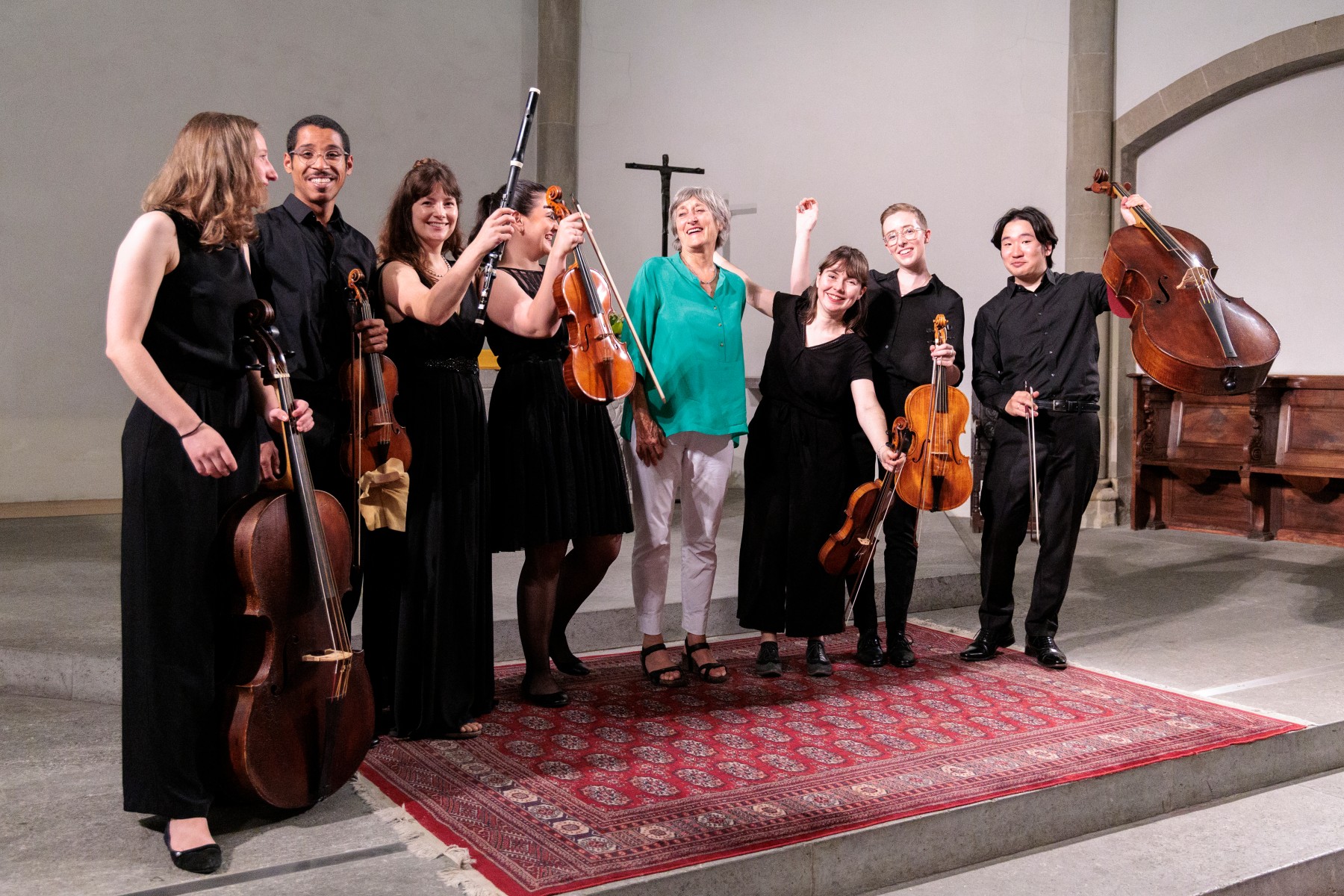
Every summer for the past seven years, Theresia has climbed up to Geneva’s Vieille Ville for two evenings at the Église St-Germain. In these occasions, the orchestra gathers around a chamber-sized stage. The bond with the Concerts d’été à St-Germain began in 2019, when Chiara Banchini, newly on its artistic committee, brought a proposal to the table.
A cycle born from a conversation
The idea, Banchini says, came the way good ideas do: from a conversation.
“Mario Martinoli came to Geneva, we talked at length with the committee, and out of that came the idea of a cycle devoted to Beethoven’s symphonies in reduced scoring. The committee loved it, so we decided to do one each year.”
And this year, that bond reaches one of its most demanding point: Carl Friedrich Ebers’s chamber arrangement of the Eroica, Beethoven’s Third Symphony recast for a handful of instruments, a highly ambitious step in the Beethoven cycle we have been building here since 2022.
It is worth pausing on why. A symphony in reduced scoring sounds, at first, like something has been taken away. But fewer players mean nothing is hidden: every line has to be heard, every player is exposed, and the audience sits close enough to follow the music thinking itself through. What the committee recognised was that this is not a smaller Eroica but a unique way of listening to this masterpeace: a nearer and more intimate one, and a church seating a few hundred people is exactly the right frame for it.
A fixture in the Geneva season
The choice has practical roots as much as artistic ones. St-Germain cannot hold a full orchestra, and the festival has always made room for young performers — of its nine concerts each season, two or three go to young groups or soloists, often from Geneva, often competition winners. Theresia sits exactly between those two things. And here is the heart of it: Theresia exists to bring the symphonic repertoire to life, music that normally asks for an orchestra. The Beethoven cycle is how we carry that heritage into a church where this music cannott be heard usually — and towards listeners who come looking for something more intimate than the great concert halls and symphonic works.
“The Concerts d’été à St-Germain have run for fifty-two years, always in the same church. When the programme is drawn up, people say: there, a Theresia concert. It’s a fixture, perhaps the only one alongside the winner of the Concours de Genève.”
Theresia began as an orchestra of young professionals gathered from across Europe and playing on period instruments as they were in use during the Classical period, when this music was written. The orchestra has no fixed home: each project is built with a network of partners, and in Geneva this year the players come together for a full residency. That international, hands-on formation is part of the point. Banchini, who taught for years at the Schola Cantorum Basiliensis in Basel, Europe’s leading centre for early music studies, sees residencies like this as where young musicians put training into practice.
She is also clear-eyed about where early music stands, and adds a positive note to the discussion about classical music education and early music.
“Look at the conservatoires today — the early-music departments keep growing. Period instruments for early music, modern instruments for modern music: in my day this wasn’t done, now it’s natural, no longer an exception.”
The 2026 programme: Gyrowetz and the Eroica
Alongside the Eroica comes a Serenade in E-flat major, Op. 3 No. 1 by Adalbert Gyrowetz — a Bohemian composer who built his career in Vienna, and of whom relatively little is known today. It is a genuine piece of Harmoniemusik, the wind music of late-eighteenth-century Viennese salons and gardens: the same intimate sound world from which the chamber transcriptions of the great symphonies would soon emerge. Think of it as the evening’s opening door — the room the Eroica will walk into.
The Eroica is where the cycle asks the most, of the players and of us.
“It’s one of Beethoven’s most incredible symphonies, almost an hour long. In four days of rehearsal we have to arrive at a truly compelling moment, because the Eroica speaks to everyone: it draws both attention and the heart.“
Why an Eroica chamber arrangement, today
There is a second reason the concert matters, and it lies in Ebers’s arrangement itself. Chamber transcriptions, extremely rare in today’s programming, were once how music travelled: without recordings or an orchestra always at hand, reducing a symphony to seven, eight, ten instruments was often the only way to bring a work like the Eroica to the people who wanted to hear it.
“I’ve never heard it in concert myself — none of Beethoven’s symphonies reduced this way. Winds and strings together make a sound far clearer and plainer than the one we know. And these are transcriptions made in Beethoven’s own day, not ours — that matters.“
That last point is what makes the arrangement valuable: it shows how musicians of Beethoven’s own time heard and understood this music. And reviving it now does something to the listening, too. When the forces shrink, the symphony comes into focus. The inner voices return one by one. Strip away the orchestral mass and the compositional thinking lies exposed: the interplay of voices, the harmonic choices, the way an idea passes from one instrument to the next a phrase you have heard a hundred times suddenly arriving from a single bassoon.
The great-hall Eroica and this one are two different experiences. The second is intimate and transparent, and closer to the work as it was made.
A training ground for young musicians
The reduced ensemble also changes what is asked of each player. With ten instruments, no one can lean on another stand: each part covers the role of several from the original, carried with a soloist’s responsibility and a chamber musician’s ear. The very practice that once sent symphonies out into the world becomes, here, how a new generation is formed.
“Ours isn’t an audience that rushes to hear the Eroica in the great halls, and it values hearing it somewhere more intimate. People ask me which symphony is next, or tell me they’ve never heard it like this. There’s a real appetite for the symphony in reduced scoring.“
For whoever leads a project like this, preparation is almost double: you have to know the orchestral score by heart in order to teach the parts.
“I need to know the orchestral Eroica by heart to work out how to coach the players.“
We look very much forward to the evenings of 2 and 3 August, for this next stage of the Theresia Beethoven cycle in Geneva.

